
You have options. Dozens of them. Wix, Shopify, Squarespace, Webflow — the list keeps growing, and the ads make every platform look like a silver bullet. So it is completely understandable if you are questioning whether WordPress for small business is still the smart move in 2026.
Here is the short answer: yes, it is. But the longer answer is the one worth reading — because it comes with some important nuance, honest comparisons, and a practical framework that could change how you think about your entire online presence.
Let us get into it.
The Current State of WordPress for Small Business in 2026
WordPress powers over 43% of all websites on the internet today. That is not a legacy stat — it is a current reality. Despite endless predictions about its decline, the platform continues to grow. And the reason is straightforward: it gives businesses something other platforms simply cannot match — true ownership, genuine flexibility, and a built-in SEO edge that compounds over time.
In 2026, WordPress is far more than a blogging tool. It is a complete content management system, an eCommerce engine via WooCommerce, a membership platform, a portfolio builder, and a lead generation machine — all in one. The Gutenberg block editor has made it significantly more intuitive. AI integrations are expanding rapidly. And the global community of developers, designers, and strategists behind it is stronger than ever.
The ecosystem is mature, well-supported, and actively evolving. So if you have been told WordPress is outdated, whoever said that was wrong.
Why WordPress for Small Business Still Makes Sense
Let us talk about what actually matters to a small business owner — cost, control, growth, and long-term value. WordPress delivers on every one of these.
It Is Genuinely Affordable
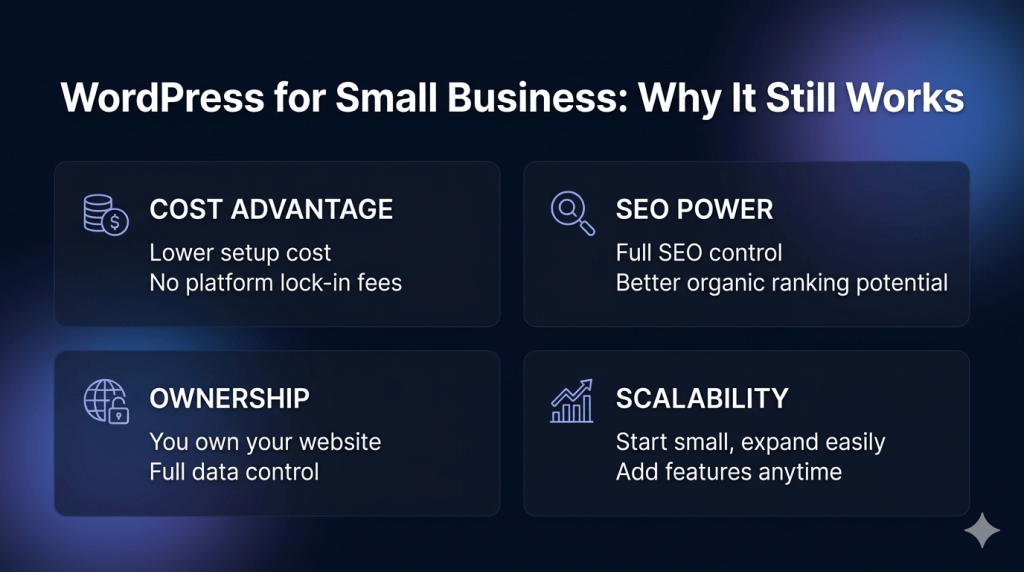
WordPress itself is free. You invest in hosting (typically from $5 to $30 per month for quality shared or managed hosting), a domain name, and any premium tools you choose. That total is almost always lower than a comparable Shopify plan or Squarespace subscription — without the platform’s ongoing transaction fees eating into your margins.
You Own Everything
This is the most underrated advantage of WordPress for small business. Your site, your content, your data — all yours. You can move hosts, change themes, switch developers, or rebuild entirely at any time. No platform holds you hostage.
With most hosted website builders, if you leave, you start from zero. With WordPress, you take everything with you. That is the difference.
The SEO Advantage Is Real
WordPress is widely regarded as the most SEO-friendly platform available to small businesses. Plugins like Yoast SEO and Rank Math give you granular control over metadata, sitemaps, schema markup, canonical URLs, and on-page optimization. If organic traffic is part of your growth strategy — and it should be — WordPress gives you far more power to pursue it.
It Scales With Your Ambitions
Start with a simple five-page site. Add a blog, a booking system, a shop, a course platform, or a membership portal as you grow. WordPress scales with your business — and that continuity saves you from the painful and expensive process of migrating platforms every few years.
Why WordPress for Small Business Sometimes Fails
Here is something most guides will not tell you: the businesses that struggle with WordPress are not struggling because of the platform. They are struggling because of how they use it.
The problem is never WordPress. It is the approach.
No Foundation, No Direction
Many small business owners launch a WordPress site without a clear strategy. They pick a random theme, install 25 plugins, and wonder why the site feels slow, confusing, and ineffective. A poor setup creates poor results. Always.
Plugin Overload
WordPress’s plugin library is one of its greatest strengths — and one of its biggest traps. Installing too many plugins without understanding dependencies or performance impact leads to conflicts, security gaps, and loading speeds that test users’ patience.
No Content or SEO Plan
A WordPress business website without a content strategy is just an expensive brochure. Many small businesses build a site, publish a few pages, and wait for traffic that never arrives. WordPress does not generate results on its own. Strategy does.
Neglecting Maintenance
WordPress requires care. Regular updates, security monitoring, backups, performance checks — these are not optional extras. Businesses that treat their site as a set-it-and-forget-it tool often end up with outdated, vulnerable websites that hurt more than they help.
However, none of these are WordPress problems. They are strategy and execution problems. And they are entirely solvable.
WordPress vs Wix vs Shopify: The Honest Breakdown
This comparison comes up constantly, so let us settle it once and for all.
WordPress vs Wix
Wix is fast and easy. Drag, drop, done. If you need a basic online presence quickly, it works. However, Wix limits your SEO capabilities at a deeper technical level, restricts your design freedom over time, and — critically — owns your platform. If Wix changes pricing or discontinues a feature, you adapt or leave. You have no say.
WordPress gives you full control. The learning curve is higher, but the long-term payoff in flexibility, SEO performance, and ownership makes it the clear winner for businesses serious about growth.
WordPress vs Shopify
Shopify is purpose-built for eCommerce and does it well. But the costs add up: monthly platform fees, transaction fees, app subscriptions, and limited built-in content marketing tools. Furthermore, your business depends entirely on Shopify’s infrastructure and pricing decisions.
With WordPress and WooCommerce, you build your store on ground you own. You gain full content marketing capabilities alongside your shop, avoid recurring platform fees, and maintain complete portability. For small businesses thinking long-term, WordPress wins on independence alone.
The fundamental question is this: do you want convenience today, or control for the future?
The WPExtent Perspective: WordPress as a Business System
Most people see WordPress as a website builder. At WPExtent, we see it differently — as a business system.
A website should not just exist. It should perform. That is the WPExtent belief, and it shapes everything we do.
When built with intention, a WordPress business website becomes your most effective team member — attracting the right visitors, converting them into leads, and scaling alongside your business.
Unlike a human team, it never clocks out or takes breaks. Instead, it works continuously in the background, 24 hours a day, seven days a week, supporting your business growth at every stage.
That shift in mindset — from website to system — changes what you build, how you build it, and what results you can expect from it. And that changes everything.
Check this: How to Audit Your WordPress Website (Step-by-Step System)
The WPExtent WordPress Growth System
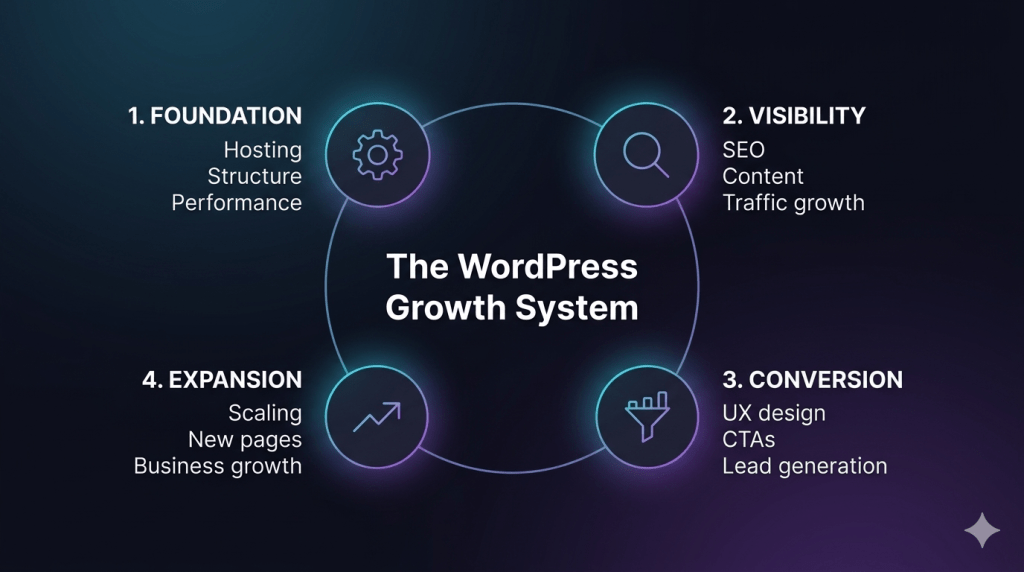
We developed this framework to help small businesses move from random website decisions to strategic, measurable growth. It is built on four pillars:
Pillar 1: Foundation
Before anything else, the base must be solid. This means fast, reliable hosting — not the cheapest shared server. A clean, lightweight theme. Proper site architecture that both search engines and real humans can navigate intuitively. Security hardening and automated backups built in from day one.
Without a strong foundation, every other investment is at risk.
Pillar 2: Visibility
A beautiful site that no one finds is a beautiful waste of money. Visibility covers your keyword strategy, on-page SEO, content plan, and organic growth roadmap. This is where WordPress for small business genuinely outperforms every competing platform — because no other tool gives you this level of control over how search engines see and rank your site.
Pillar 3: Conversion
Traffic is only valuable if it converts. Conversion focuses on user experience design, page layout, calls-to-action, and funnel structure. Every page should have a purpose. Every visit should move the user toward a clear next step. Most WordPress sites fail here — not because of the platform, but because conversion is rarely planned from the start.
Pillar 4: Expansion
Once foundation, visibility, and conversion are working, the system is ready to scale. New content verticals, new product lines, new markets — the Expansion pillar ensures your WordPress site grows with your business, not against it.
This is how we think at WPExtent. Not websites. Growth systems.
When WordPress for Small Business Is the Best Choice
WordPress delivers exceptional results in these specific situations:
- Service-based businesses — agencies, consultants, coaches, clinics, and freelancers who rely on credibility, SEO visibility, and content to attract clients.
- Content-driven brands — businesses that use blogging, education, or thought leadership as their primary marketing engine.
- SEO-focused businesses — any brand where organic search is a key growth channel. WordPress gives you more control here than any other platform.
- Businesses planning long-term growth — if you are thinking in years, not months, WordPress gives you the infrastructure to evolve without ever starting over.
When WordPress Is NOT the Right Choice
Transparency builds trust — so let us be direct.
- You need a one-page site with no future content plan. A simpler tool like Carrd might honestly serve you better.
- You have no intention of maintaining the site. WordPress needs regular care. Without it, it becomes a liability, not an asset.
- You need a pure eCommerce store with no content strategy. In this narrow case, a platform like Shopify may offer a faster setup with fewer decisions to make.
Knowing when a tool is not the right fit is a sign of expertise, not weakness. We would rather help you make the right decision than push you toward the wrong one.
From Invisible to Fully Booked: A Small Business Story
Picture a three-person interior design studio in a mid-sized city. Solid work. Happy clients. Zero online presence beyond a Facebook page updated twice a year and a basic Wix site with stock photos nobody noticed.
They moved to WordPress — not just a new design, but a complete growth system built on the WPExtent framework. A blog covering interior design tips for homeowners in their specific area. Local SEO optimization across every page. A portfolio structured like case studies — showing process, outcomes, and transformation. A simple lead form that filtered serious inquiries from casual browsers.
Eight months later: organic traffic had tripled. Inquiries had doubled. They hired a fourth team member to manage demand. No paid ads. No viral moment. Just a WordPress site used strategically.
That is the difference between a website and a business system.
Quick Summary: Is WordPress Worth It in 2026?
WordPress for Small Business — 2026 Verdict
✅ One of the most cost-effective long-term solutions for small businesses
✅ Strong SEO performance compared to most website platforms
✅ Complete ownership with no platform dependency or restrictions
✅ Scales easily as your business grows over time.
⚠️ However, it does require proper setup, strategy, and ongoing maintenance
⚠️ It may not be the right choice for users who want zero maintenance or a simple one-page site
Frequently Asked Questions
Is WordPress good for small business websites?
Yes — WordPress is one of the best platforms for small business websites. It offers complete ownership of your content and data, unmatched SEO capabilities, and the flexibility to grow in any direction your business takes. With the right setup and strategy, it consistently outperforms other platforms for long-term results.
Why do small businesses choose WordPress over other platforms?
Small businesses choose WordPress because it is cost-effective, highly flexible, and SEO-friendly. Unlike hosted platforms, WordPress gives you full control over your site without ongoing platform fees or restrictions. It also scales effortlessly — from a simple brochure site today to a full eCommerce store or membership platform tomorrow.
Is WordPress better than Wix or Shopify for small businesses?
For most small businesses focused on growth, SEO, and long-term value, yes. Wix offers more convenience upfront but less control and weaker SEO over time. Shopify is excellent for pure eCommerce but adds ongoing costs and limits your content marketing. WordPress offers the best combination of ownership, flexibility, and organic growth potential.
How much does a WordPress website cost for a small business?
A professionally built WordPress business website typically costs between $500 and $5,000+ depending on complexity, features, and the team behind it. Ongoing costs include hosting ($10 to $50/month), any premium plugins or themes, and maintenance. Despite the upfront investment, WordPress is almost always more affordable long-term than competing platforms with recurring fees.
Is WordPress hard to maintain for a small business owner?
WordPress does require regular maintenance — updates, backups, security monitoring, and occasional plugin management. However, it is far from unmanageable. With the right hosting provider, a basic maintenance plan, or a support partner like WPExtent, the upkeep is straightforward and takes minimal time each month.
Is WordPress still worth it in 2026?
Absolutely. WordPress continues to power over 43% of the web in 2026 and shows no signs of slowing down. The platform has evolved significantly — with improved editors, AI integrations, and a thriving ecosystem of tools. For small businesses serious about online growth, WordPress remains the most powerful, flexible, and cost-effective platform available.
Does WordPress help with SEO for small businesses?
Yes — significantly. WordPress provides more SEO control than any major competing platform. With plugins like Yoast SEO or Rank Math, you can manage metadata, sitemaps, schema markup, canonical tags, and content optimization from one intuitive dashboard. For businesses where organic search matters, this is a game-changing advantage.
Final Thoughts: Is WordPress for Small Business Still Worth It in 2026?
Here is the truth, stated plainly: WordPress is not outdated. It is not overly complicated. It is, however, widely misunderstood — and that misunderstanding costs small businesses real growth every single year.
The businesses that win with WordPress approach it with intention. They build on a solid foundation, create content with purpose, and design for conversion instead of just aesthetics. Most importantly, they think in years, not just launch days.
WordPress for small business works — but only when it is treated as a growth system, not just a website.
At WPExtent, we don’t just build websites—we build systems that grow with your business.
That means creating a strategic, scalable foundation that attracts the right audience, converts visitors into customers, and evolves alongside your goals over time.
If you are ready to stop guessing and start building with intention, you already know the next step.
Follow WPExtent for More Insights
Get practical WooCommerce tips, conversion strategies, and real-world insights to grow your online business.
We Are Available On:
Instagram:
https://www.instagram.com/thewpextent
Twitter (X):
https://x.com/TheWPExtent
Reddit:
https://www.reddit.com/user/WPExtent/


Leave a Reply