

Every week, another headline declares that AI is changing everything. And in many ways, it is. But one question keeps surfacing among business owners, marketers, and founders: will AI replace websites? It is a legitimate concern — and one worth answering clearly, without hype on either side.
ChatGPT now handles millions of queries that used to end on a website. Google’s AI Overviews serve direct answers before a single result is clicked. No-code AI builders promise functional websites in under a minute. On the surface, the website looks like it is being outmaneuvered.
Look closer, though, and a very different picture emerges. AI is changing the front end of the internet. It is not replacing the destinations that actually matter. In this guide, we break down what AI genuinely changes, what it cannot touch, and what smart businesses are doing right now to stay ahead.
Will AI Replace Websites? Why the Question Matters Now
The conversation around AI replacing websites is not theoretical — it is driven by real shifts in how the internet works. Three forces are fuelling the concern.
First, tools like ChatGPT are answering complex questions directly, reducing the need for a user to click through to a source. Second, Google’s AI Overviews now appear above traditional organic results, compressing website traffic for certain query types. Third, no-code AI builders and automation platforms are making it faster than ever to spin up a basic online presence.
Each of these is a real development. None of them, however, signals the death of the business website. They signal that the bar for a valuable website is rising — and that businesses which understand this distinction will pull significantly ahead of those that do not.
What AI Can Genuinely Replace on a Website
To answer this honestly, we should start with what AI does well. There are specific website functions where AI-powered tools already outperform human effort in terms of speed, scale, and cost-efficiency.
Tasks AI Handles Effectively
- Answering routine FAQ queries through intelligent chatbots
- Generating templated copy for low-stakes promotional pages
- Writing bulk product descriptions and category metadata
- Automating lead qualification, appointment routing, and email follow-up
- Summarising support tickets and triaging customer service queues
- Suggesting A/B test variations based on behavioural data
These capabilities are real and genuinely useful. For businesses drowning in repetitive tasks, AI integration provides meaningful efficiency gains.
But notice what these tasks share: they are transactional, surface-level, and scalable precisely because they do not require nuance, trust, or strategic judgement. The moment a business need crosses into brand identity, persuasion, or relationship-building — AI runs out of road.
“AI can answer questions. Websites close decisions. Those are not the same thing.”
Will AI Replace Websites? What It Cannot Touch
Here is the core of the argument. The functions that drive real business outcomes — converting visitors, earning trust, establishing authority, and retaining customers — are precisely what AI cannot replicate.
Trust and Brand Identity
Trust is not a chatbot feature. It is built through design decisions, consistent voice, verified social proof, and a brand experience that feels considered and intentional. When a prospective customer lands on your website, they are running a rapid, largely unconscious assessment: does this business look legitimate? Does it feel like someone I would trust with my money?
AI-generated content can inform. It cannot convey the earned authority of a brand that has shown up consistently, built a reputation over time, and made deliberate choices about how it presents itself. Online trust is still a deeply human judgment — and websites remain the primary arena where it is established.
Ownership and Digital Real Estate
Traffic can be rented, but trust must be owned. Social media followers exist on platforms you don’t control, and AI search visibility depends on algorithms that can shift overnight. A properly maintained website, however, remains yours indefinitely — including your audience, content history, SEO equity, and first-party data.
This is not a small distinction. It is the difference between building on land you own and building on land you lease. Businesses that understand digital ownership are systematically more resilient than those chasing platform-dependent reach.
Conversion Architecture
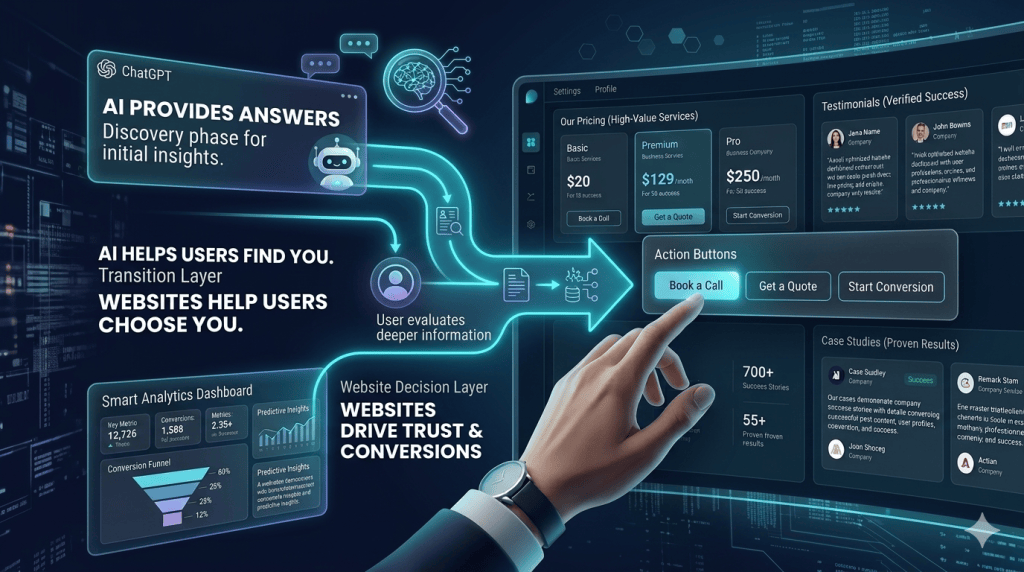
Getting someone to buy, book, or subscribe is not a transaction — it is a journey. That journey runs through landing pages, product comparisons, testimonials, pricing pages, case studies, and calls to action that are carefully sequenced and tested. AI can assist elements of this architecture. It cannot design the strategy behind it, understand what makes a specific audience hesitate, or build the kind of trust that converts a sceptical visitor into a paying customer.
Emotional Resonance and Storytelling
The best business websites do not just present information — they make you feel something. They communicate ambition, warmth, reliability, or innovation through design, copy, and experience. That emotional layer is what separates a website that gets remembered from one that gets closed. No AI summary delivers it.
Why Websites Still Drive Real Business Results
Step back from the AI conversation for a moment and look at what a well-built website actually does for a business. The functions remain as valuable as ever.
- Generates leads through optimised landing pages, gated content, and contact forms that work around the clock
- Builds SEO visibility through a compounding content strategy that earns search traffic over time
- Establishes credibility through case studies, client testimonials, certifications, and transparent pricing
- Educates customers through blog content, guides, and product pages that address real purchase questions
- Owns the data — first-party analytics showing who visits, what they read, where they leave, and what converts
- Drives sales conversions through structured purchase flows and trust-building UX patterns
There is also a dimension that is easy to overlook: AI Overviews and AI search tools are trained on real web content. The websites producing authoritative, expert-level content are the very sources that AI draws upon. Removing your website from the web does not protect you from AI disruption — it removes you from the conversation entirely.
“Traffic can be rented. Trust must be owned. Your website is where that trust lives.”
The Future of Websites in the AI Era
The most accurate frame for this conversation is not replacement — it is evolution. Websites are not disappearing; they are becoming more capable, more personalised, and more strategically important.
What AI-Enhanced Websites Will Look Like
- Dynamic content that adapts to each visitor based on behaviour, location, and intent signals
- Intelligent on-site chat that goes far beyond scripted FAQ trees
- Predictive user journeys that surface the right information at exactly the right moment
- Automated content optimisation based on real-time performance signals
- AI-driven internal search that understands context and intent, not just keywords
The future belongs to stronger websites — not fewer of them. Businesses investing in AI-enhanced web experiences today are building a compounding advantage that will be very difficult for slower-moving competitors to close.
Why WordPress Still Leads in the AI Era
Among all available platforms, WordPress CMS is uniquely positioned for what is coming. Here is why it continues to be the platform of choice for serious business growth.
- Full ownership of your site, data, and hosting — with no platform lock-in risk
- Unmatched flexibility to build any type of site, from lean service pages to complex e-commerce operations
- Deep SEO control through tools like Yoast SEO and Rank Math, giving granular optimisation at scale
- A rapidly expanding ecosystem of AI-powered plugins and integrations already available and maturing
- Proven scalability from startup blog to enterprise content operation — without rebuilding
- Custom development paths that proprietary closed-source builders simply cannot match

At WPExtent, we have watched WordPress adapt through every major web shift — mobile, social, voice search, and now AI. Each time, the platform’s open architecture has made it one of the most integration-ready options available. That pattern is holding true again now.
If your WordPress website has not been reviewed against current SEO and performance benchmarks, now is exactly the right time. WPExtent helps growing businesses build future-ready websites designed for search, speed, and long-term growth. Learn how we can help → wpextent.com
AI Tools vs Websites: What Each Does Best
The distinction is not about which is better — it is about understanding what each is actually built to do. AI and websites serve fundamentally different purposes, and the businesses that understand this build more intelligently.
| What AI Tools Handle | What Websites Handle |
| Quick answers & conversational summaries | Deep brand storytelling and emotional persuasion |
| Automated FAQ and support responses | Building verified trust and long-term credibility |
| Generic content generation at scale | Unique value propositions and expert positioning |
| Routine lead qualification workflows | Strategic conversion journeys from visitor to customer |
| Basic workflow and email automation | Full data ownership and first-party analytics |
| No-code template page generation | Custom user experiences and intentional UX design |
| AI Overview summaries in search results | SEO authority, backlinks, and domain reputation |
| Content drafting assistance | Brand identity, voice, and audience relationship |
Used together strategically, AI tools and strong websites are genuinely complementary. The mistake is treating them as interchangeable.
What Smart Businesses Should Do Right Now
If you run a business with an online presence, here is a practical framework for staying competitive as AI reshapes the search landscape.
- Audit your Core Web Vitals and site speed — AI-era users and Google’s ranking signals both reward fast, frictionless experiences
- Invest in long-form, expert-level content that AI tools cannot easily compress into a one-sentence summary
- Publish consistently and build topical authority so your site becomes a source that AI search references and cites
- Strengthen your trust signals — verified reviews, case studies, named team members, and transparent pricing all matter more as AI commoditises generic content
- Integrate AI tools wisely into your workflow — use them for scale and efficiency without surrendering brand voice
- Optimise your conversion architecture: review landing pages, lead forms, and calls to action with fresh eyes
- Protect your owned traffic channels through email subscribers, direct search traffic, and returning audience members
- Review all existing content against E-E-A-T standards — depth, accuracy, and genuine expertise are the new floor
Many growing brands trust WPExtent for scalable WordPress solutions built specifically for these challenges — websites that perform for search, for users, and for business outcomes simultaneously.
“AI may open the door. But a great website is what wins the business.”
Frequently Asked Questions
Q1: Will AI replace websites completely?
No. AI is reshaping how people discover and access information online, but it does not replace what websites do best — building brand trust, driving conversions, and providing a platform you fully own. In fact, AI search tools like ChatGPT and Google AI Overviews frequently draw from high-quality websites, making a strong web presence more strategically valuable, not less.
Q2: Do businesses still need websites in 2026?
Absolutely. In 2026, a well-built website remains the primary engine for lead generation, search visibility, customer credibility, and sales conversions. While social platforms and AI tools are valuable traffic channels, they cannot replace the control, depth, and first-party data ownership that a professionally built website provides. Your website is an asset. Everything else is rented space.
Q3: Can AI build websites automatically?
AI-powered builders can generate basic templates and draft copy quickly — and that is genuinely useful for getting started. However, they cannot deliver the strategic design thinking, brand consistency, custom conversion architecture, or authoritative content that earns sustained search rankings. AI is a capable starting tool, not a complete website strategy.
Q4: Is WordPress still worth building on in the AI era?
Without question. WordPress offers full ownership, deep SEO control, unmatched flexibility, and an expanding ecosystem of AI integrations. Its open architecture has adapted to every major web shift — mobile, voice search, and now AI. For businesses that want scalability, customisation, and long-term digital resilience, WordPress CMS remains the most proven and future-ready platform available.
Q5: How can websites benefit from AI tools?
The opportunities are substantial. Websites can use AI for personalised content experiences, smart on-site chat, predictive user journeys, automated A/B testing, content gap analysis, and more efficient SEO workflows. When applied strategically, AI makes a well-built website significantly more capable — reinforcing the case for investing in a strong web foundation rather than replacing it.
Conclusion
So, will AI replace websites? No — and the more you understand how AI actually works, the clearer that becomes.
AI is changing the way people discover information. It is compressing certain types of website traffic. It is raising the bar for what qualifies as useful, trustworthy content. None of these things make your website less important. In many respects, they make it more important — because the businesses that invest in genuine authority, excellent UX, and owned digital assets are exactly the ones that AI search will draw from and direct users toward.
The future of online business is not AI or websites. It is AI and websites, working in concert. The discovery layer is becoming AI-mediated. The trust layer, the conversion layer, and the relationship layer remain deeply tied to the experience your website delivers.
Own your platform. Build your authority. Use AI to enhance rather than replace. That combination is not just a strategy for surviving the AI era — it is a strategy for leading it.
Build Your Future-Ready Website with WPExtent
If your business needs a WordPress website built for SEO performance, speed, long-term authority, and real conversions — WPExtent is here to help. We build websites that work today and are designed for whatever comes next.
Follow WPExtent for More Insights
Get practical WooCommerce tips, conversion strategies, and real-world insights to grow your online business.
We Are Available On:
Instagram:
https://www.instagram.com/thewpextent
Twitter (X):
https://x.com/TheWPExtent
Reddit:
https://www.reddit.com/user/WPExtent/



Leave a Reply