
A few years ago, AI tools in digital agencies were a nice extra — something to experiment with on the side. Today, they are part of the core workflow. AI writes copy, runs ad campaigns, builds audience lists, generates images, and produces reports. The speed is impressive. The cost savings are real. But a big question is being quietly ignored in most agencies: are we using these tools in the right way?
The ethics of AI in digital agencies is not just a topic for tech philosophers. It affects real things — your clients’ data, the fairness of your campaigns, the honesty of your work, and the jobs of your team members. If you get it wrong, the damage goes beyond a bad news story. You can lose client trust, break the law, or cause real harm to real people.
This guide cuts through the noise. No jargon. No theory for theory’s sake. Just a clear, practical look at the main ethical challenges agencies face with AI — and what you can actually do about them.
78%
of clients want to know when AI is used in their work (Edelman, 2024)
61%
of marketing teams use AI tools without any formal ethics guidelines
$12B
in GDPR fines issued since 2018 — AI data misuse is the fastest-growing category
3×
more likely to win pitches — agencies with a clear AI ethics policy vs. those without
1. Why AI Ethics Matters for Digital Agencies Right Now
Let’s be honest. Most agencies adopted AI tools quickly, with more focus on speed than safety. That made sense early on — the tools were new, the rules were unclear, and everyone was figuring it out. But things have changed. Clients are asking harder questions. Regulators have written new laws. And the public is paying much closer attention to how brands use AI.
Here is the simple truth: every time you use AI in client work, you are making a promise. A promise that the data is safe. A promise that the output is fair. A promise that you are being honest about what you did. Those promises matter — and right now, a lot of agencies are making them without thinking them through.
The agencies that will thrive over the next five years are not the ones that use AI the most. They are the ones that use it the most responsibly. That starts with understanding what the real risks are.
The agencies that will lead the next decade are not the ones who use AI the fastest — they are the ones who use it most responsibly.
2. The Six Core Principles of Ethical AI
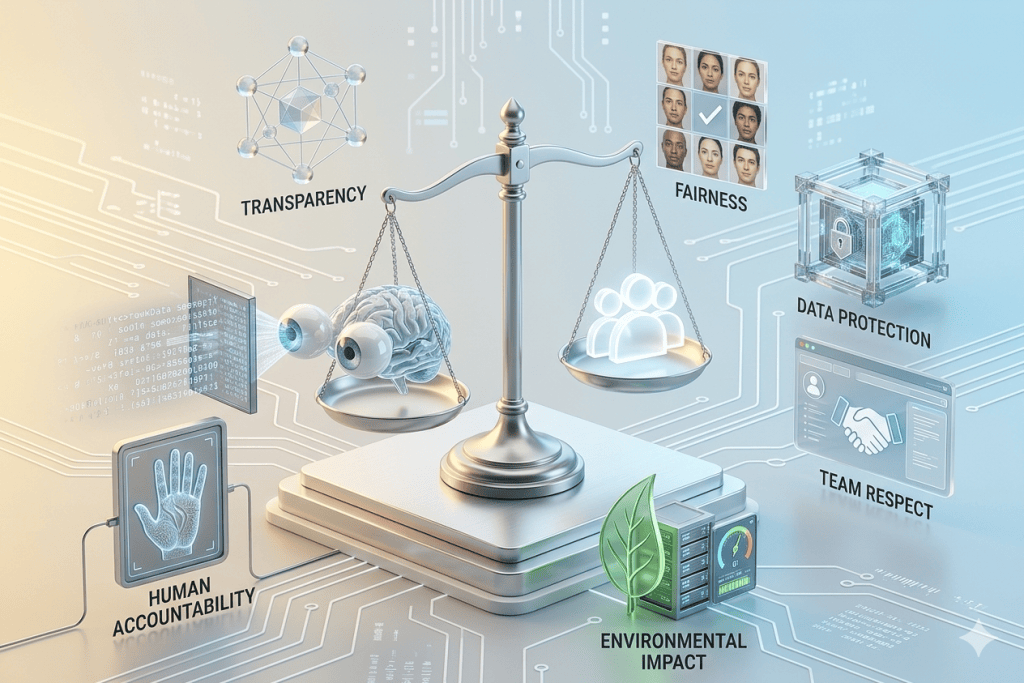
Responsible AI use in a digital agency comes down to six simple ideas. These are not complicated — but you need to actually build them into your day-to-day work, not just hang them on a wall.
🔍
Be Honest
Tell clients when AI was involved in their work. Hiding it is not clever — it is a risk to your reputation and their trust.
⚖️
Be Fair
Check your AI outputs for hidden bias. AI can discriminate without anyone meaning to — so you need to look for it on purpose.
🔒
Protect Data
Treat client and customer data like it is yours to lose — because if something goes wrong, it is. No data goes into an AI tool without proper permission.
🧭
Take Responsibility
A human must always be accountable for every piece of work that involves AI. "The AI did it" is not an excuse clients or regulators will accept.
🌱
Think About Impact
Running large-scale AI tools uses a lot of energy. Be aware of the environmental cost and choose tools from providers who take sustainability seriously.
🤝
Respect Your Team
AI should help your people, not quietly replace them. Be upfront with staff about how AI is being used and what it means for their roles.
3. Keeping Client Data Safe When Using AI
This is the most urgent issue on the list — and the one that could get you into the most serious legal trouble if ignored. When you use AI tools, data goes somewhere. The question is: do you know exactly where it goes, and do you have the right to send it there?
Think about a typical agency day. A strategist pastes a client’s campaign brief into an AI writing tool. A data analyst uploads a customer segment to an AI analytics platform. A designer feeds brand assets into an image generation tool. In each case, sensitive client information has left your building — often going to a third-party AI company’s servers. Does your client know that? Did they agree to it? Does your contract allow it?
For most agencies, the honest answer is: probably not. And that is a real problem.
Simple Steps to Keep Data Safe
- Do a quick audit. List every AI tool your team uses. For each one, find out what happens to the data that goes in — especially whether it is used to train the AI model.
- Update your client contracts. Your agreements should clearly say which AI tools you use, what data they process, and who is responsible if something goes wrong.
- Check your AI tool vendors. Read the small print. Ask your vendor directly: does our data get used to train your model? Where is it stored? What happens if there is a data breach?
- Create a simple data classification system. Label your data as public, internal, confidential, or restricted — and decide which types are allowed into which AI tools.
- Train your team regularly. Even careful people make mistakes. Run a short session every few months on what can and cannot go into AI tools.
Golden Rule
Before you put anything into an AI tool, ask yourself: if my client could see exactly what I just entered, would I be comfortable? If the answer is no — don’t enter it.
4. AI Bias: What It Is and Why It Is Your Problem Too
AI bias sounds like a technical problem that someone else needs to solve. It is not. When AI tools give unfair results — showing certain ads only to certain groups, giving some audiences worse content than others, or generating images that rely on stereotypes — that happens on your watch. And your client’s name is attached to the output.
Here is why it happens: AI systems learn from past data. That data reflects the real world — including all its unfairness. So an AI trained on historical hiring decisions might learn to favour male applicants. An ad-targeting algorithm trained on old consumer data might systematically underspend in diverse communities. The AI is not doing this on purpose. It is just repeating patterns it was taught.
The result can be real harm to real people — and serious legal and reputational risk for the brands and agencies behind the campaigns.
How to Spot and Reduce AI Bias
- Break down your results by group. Instead of just looking at overall campaign performance, check how your AI-driven campaigns perform across different genders, age groups, and communities. Unusual gaps are a warning sign.
- Test your AI content tools. Ask AI image generators and writing tools to produce content about diverse groups. Look carefully at the results — are they relying on stereotypes?
- Ask your vendors hard questions. A responsible AI vendor should be able to tell you how their model was trained, what fairness checks were done, and how they deal with known bias issues.
- Put a human in the loop for big decisions. If an AI tool is making decisions that could affect a whole group of people — who sees an ad, who gets a promotion, who receives a certain price — a human should review it before it goes live.
⚠ Law Change Alert — 2025
The EU AI Act is now fully in force. It marks certain AI uses in advertising and employment as “high risk” — meaning they require bias checks, written documentation, and human review before use. If you work with EU-based clients or target EU audiences, this applies to you.
5. Being Honest With Clients About AI
Many agencies are nervous about telling clients they use AI. They worry it will seem like they are cutting corners, or that clients will think they are paying for less. This is the wrong way to think about it.
Your clients already know AI is being used across the industry. What they want is an agency that is open about it, careful about how it is applied, and clear about where real human skill still makes the difference. Honesty here is not a weakness — it is a sign of professionalism.
The agencies that are quietly using AI while presenting everything as fully human-made are taking a real risk. If a client finds out — and clients often do — the trust damage is severe and fast.
What Good AI Transparency Looks Like
- At the pitch stage: Be upfront about which parts of your process use AI tools. This sets the relationship on honest ground from day one.
- In your deliverables: Where AI was used to help produce something, say so — even just a brief note in the accompanying documentation.
- In your client agreement: Add a short section that explains your agency’s approach to AI — what tools you use, how data is protected, and how humans review everything.
- For content that goes public: If AI helped write or design something that will be published in your client’s name, check what the relevant disclosure rules say in your region and follow them.
- With your own team: Your staff should always know which parts of their work involved AI. If they don’t know, they can’t spot errors or improve outputs effectively.
Being open about AI is not a threat to your value. It is the foundation of it.
6. AI-Written Content: Who Owns It? Is It Legal?
If your agency uses AI tools to write copy, create images, or produce other content, there are two important questions you should be able to answer: who legally owns what the AI created, and could any of it land you in a copyright dispute?
Right now, the law in most countries is clear on one point: AI-generated content is not automatically protected by copyright the way human-created content is. This means content your agency produces using AI tools may have weaker legal protection than content your team creates from scratch. Clients need to know this — especially if they plan to defend their brand assets legally.
There is also the question of what the AI learned from. Most large AI models were trained on huge amounts of existing content from the internet — books, articles, images, music. Several legal cases are challenging whether this kind of training counts as copyright infringement. The law has not settled this yet. Until it does, there is a small but real risk that AI-generated content could too closely resemble existing copyrighted work.
How to Protect Your Agency and Your Clients
- Always have a human review, edit, and take ownership of AI-generated content before it goes to the client.
- Tell clients honestly that AI was part of the production process — including what this might mean for copyright ownership.
- Use AI tools that offer clear terms about ownership of outputs and that have policies for avoiding reproduction of copyrighted material.
- For high-stakes creative work — brand names, taglines, flagship campaigns — rely more heavily on human creativity and less on AI generation.
- Ask a lawyer who knows digital and IP law to review your agency’s position if you are producing large volumes of AI content for clients.
7. What AI Means for the People on Your Team
The ethics of AI in digital agencies is not just about clients and legal rules. It is also about the people who work for you. This is the conversation that agency leaders find most uncomfortable — and the one that most urgently needs to happen.
AI is already changing jobs in agencies. Junior copywriters are seeing AI tools handle tasks that used to be their starting point. Entry-level analysts are finding that dashboards now do in seconds what used to take them days. Production work that once needed a designer is now being done by an image generator in minutes. None of this is hypothetical. It is happening right now.
The ethical question is not whether to use AI — for most agencies, some level of AI adoption is simply necessary to stay competitive. The question is how you do it. Agencies that use AI purely to cut headcount, without investing in their people, are making a short-term choice that will cost them long-term. They will lose good staff, hollow out their talent pipeline, and eventually find they have no genuine human expertise left to offer clients.
How to Treat Your Team Fairly in the Age of AI
- Tell people early. Let your team know about AI adoption plans before you roll anything out — not after. Surprises damage trust fast.
- Invest in training. Help your people learn to use AI tools well. Those who can work alongside AI are more valuable, not less.
- Be honest about what AI does and does not replace. Strategy, creative judgment, client relationships, and problem-solving — these are still very much human skills. Communicate that clearly.
- Ask your team for input. The people doing the work often have the best ideas about where AI helps and where it actually creates more problems. Listen to them.
- Protect learning opportunities for junior staff. If AI handles the tasks that used to teach junior team members, find new ways to build those skills. Your future senior staff depend on it.
8. How to Build an Ethical AI Policy (Step by Step)
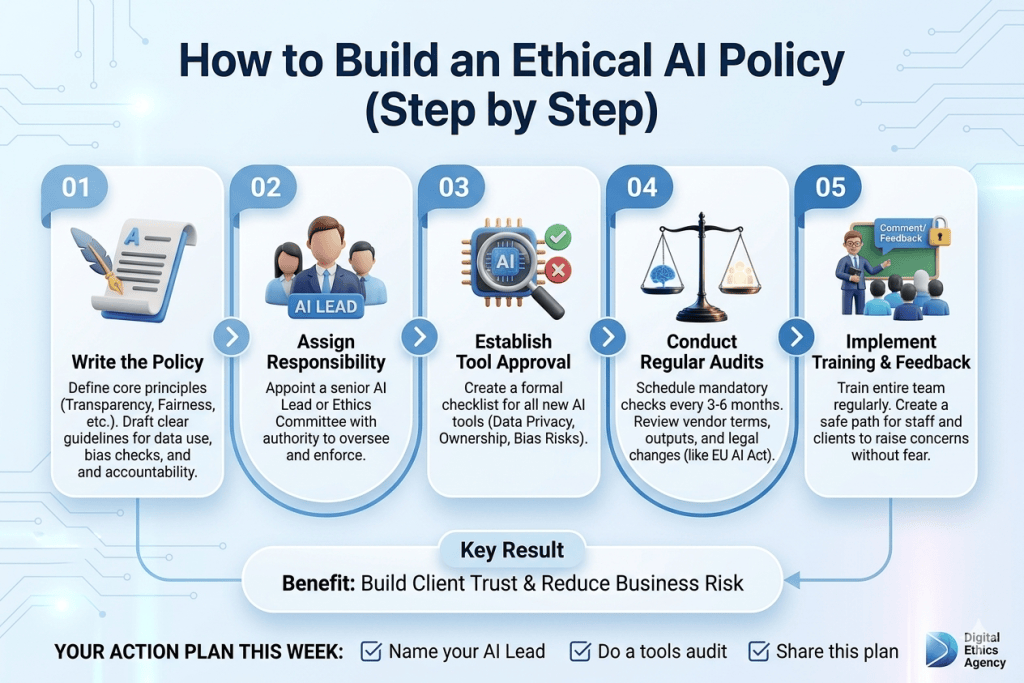
Good intentions are a start, but they are not enough. If you want to use AI ethically, you need to write things down, assign responsibility, and check in regularly. Here is a simple five-step framework to get you started.
01
Write an AI Ethics Policy
Put your principles in writing. Cover what AI tools you use, how data is protected, how you handle bias, and how humans stay accountable for all outputs. Make this available to clients — it builds confidence.
02
Name an AI Lead
Assign one senior person — or a small team — to be responsible for AI ethics in your agency. This does not need to be a new hire. It just needs to be someone with enough authority to actually make changes.
03
Create a Tool Approval Process
Before anyone in your agency starts using a new AI tool, run it through a quick checklist: What data does it use? Who owns the outputs? What are the data protection terms? What bias risks does it carry?
04
Check In Regularly
AI tools change fast. Laws change fast. Set a date every three to six months to review your tools, your policy, and any new risks or rules that have emerged.
05
Create an Open Door for Concerns
Make sure your staff and clients have a clear, easy way to raise an AI ethics concern without feeling awkward about it. People on the ground often spot problems before leadership does.
Agency AI Ethics Readiness Checklist
- ✅ We have a written AI ethics policy that clients can read
- ✅ We have checked every AI tool we use for data privacy terms
- ✅ Our client contracts mention AI use and data handling
- ✅ We tell clients when AI was used in their deliverables
- ✅ We check campaign results for signs of AI bias
- ✅ We have a named person responsible for AI ethics
- ✅ We have a training plan to help staff work well with AI tools
- ✅ We have taken legal advice on AI content and copyright
- ✅ We are tracking the EU AI Act and local regulations
- ✅ We have a way for staff and clients to raise AI concerns
9. Laws and Rules You Need to Know in 2025
The legal landscape around AI has moved quickly. Here is a plain-English summary of the rules that matter most for digital agencies right now.
The EU AI Act
This is the world’s most detailed AI law, and it came into full force in 2025. It groups AI tools by risk level. High-risk uses — including some types of AI in advertising and hiring — must meet strict requirements: bias checks, written documentation, and regular human review. If you work with EU clients or target EU audiences, this law applies to you even if your agency is based outside Europe.
GDPR and AI
The GDPR has always applied to how agencies handle personal data — but regulators are now applying it more specifically to AI. Key points: you need a clear legal reason to process personal data through AI tools, your vendors need proper data processing agreements in place, and people have the right to know when significant decisions about them were made by an automated system.
UK Data and AI Rules
The UK is taking a lighter-touch approach than the EU, but existing regulators — including the ICO (for data), the CMA (for competition), and Ofcom (for online content) — are all actively developing AI-specific guidance. UK agencies should follow ICO updates on AI and data protection closely.
FTC Rules in the US
The US Federal Trade Commission has made clear that existing advertising rules apply fully to AI-generated content. That means fake reviews, made-up testimonials, and misleading AI-generated claims are all illegal under current rules — no new AI-specific law needed. Agencies producing this kind of content for US clients are taking on real legal risk.
10. Why Ethical AI Is Actually Good for Business
If you have read this far, you might be thinking: this is a lot of extra work. And yes, building a proper ethical AI practice takes effort. But here is the thing — it pays off in ways that are very concrete.
It wins pitches. When a client asks how your agency uses AI — and they will ask — the agency with a clear, confident, written answer wins. The one that fumbles or dodges, loses.
It retains clients. Trust is the foundation of every long agency-client relationship. Clients who know you are using AI carefully and honestly are far less likely to leave than those who feel they were kept in the dark.
It attracts better talent. The most skilled creatives, strategists, and data people are increasingly choosy about where they work. An agency with a clear, ethical AI culture is genuinely more attractive to the people you most want to hire.
It reduces risk. Every hour you spend building a proper AI ethics framework is time that reduces your exposure to data breaches, regulatory fines, bias complaints, and copyright disputes. Prevention is far cheaper than the cure.
Ethical AI is not just the right thing to do. It is also a smart business strategy — and the agencies that treat it that way will have a real advantage over those that keep treating it as an optional extra.
· · · ✦ · · ·
To Sum It All Up
AI is not going away. If anything, it will become even more central to how digital agencies work over the next few years. The agencies that navigate this well are not the ones that ignore the ethical questions — they are the ones that face them head on.
The good news is that getting this right does not require a huge budget or a team of specialists. It requires honesty with your clients, fairness to your team, care with your data, and the discipline to write your principles down and actually follow them.
Start with the checklist above. Pick one thing you can do this week. Then do the next thing. Ethical AI is not a destination you arrive at — it is a habit you build, one decision at a time.



Leave a Reply