

Imagine logging in on a Monday morning and finding your website offline. Customers cannot reach you. Sales stop. Your inbox fills with confused emails asking what happened. For many business owners, this scenario is not a nightmare — it is a routine consequence of neglected hosting and domain management.
In 2026, your website is more than a digital business card. It is your shopfront, your sales team, and often your first impression. However, behind every smooth-running site sits a quiet stack of moving parts: servers, DNS records, SSL certificates, backups, and renewals. When even one piece fails, the whole customer experience breaks.
In our experience managing business websites across industries, owners almost always discover these problems only when something goes wrong. Moreover, the cost of fixing emergencies is far higher than the cost of preventing them. Therefore, treating your website infrastructure as an ongoing responsibility — not a one-time setup — has become essential for any serious brand.
That is exactly the gap WPExtent was built to close. We partner with small businesses, agencies, and growing brands that want their websites handled by people who actually understand the technical layer. Throughout this guide, we will walk through what hosting and domain management really involves, why it matters, where businesses get stuck, and how ongoing technical care protects revenue, reputation, and growth.
Whether you run a five-page service site or a busy online store, the principles below apply. Furthermore, the gaps we describe are the same ones we see across industries — from local clinics and law firms to SaaS platforms and design studios. Let’s start with the basics.
What Is Hosting and Domain Management?
These two services are related but distinct, yet they keep your website online and reachable when combined. Although people often lump them into one bucket, treating them as separate disciplines explains why so many websites quietly run into trouble.

Hosting is the physical and software environment where your website lives. Think of it as the building your shop sits in — servers, storage, bandwidth, security layers, and the software that serves your pages to visitors.
Domain management covers everything tied to your website’s name. That includes registrations, renewals, DNS records, email routing, redirects, and ownership protection.
When you combine the two, you get a coordinated approach to keeping your site fast, secure, and findable. In practice, however, these two areas often live in different dashboards, get billed by different vendors, and end up nobody’s clear responsibility. Consequently, that gap is where problems quietly grow.
Why Hosting and Domain Management Matters for Businesses
Strong technical care directly affects four areas that define the health of your online business. Each one quietly influences how customers find you, trust you, and choose you over a competitor.
Performance Impact
A slow server adds seconds to every page load. Furthermore, those seconds compound across mobile users, paid traffic, and returning customers. According to Google’s Core Web Vitals, slow sites lose visitors before content even appears on screen.
SEO Impact
Google increasingly rewards sites that are fast, stable, and HTTPS-secured. Conversely, sites that frequently drop offline, lose SSL certificates, or suffer DNS errors quietly lose rankings — often without any obvious warning in your analytics.
Security Impact
Outdated server software, weak SSL configurations, and unmonitored domains are common attack surfaces. Additionally, expired domains can be hijacked within hours, sometimes redirecting your customers to fraudulent destinations.
Uptime Impact
Every minute offline is a minute your competitors are not. For e-commerce, downtime translates directly into lost transactions; for service businesses, it translates into lost trust. In short, your website infrastructure is the foundation that every other marketing effort depends on.
Common Problems Businesses Face
We regularly see the same issues across clients before they come to us. Most start small, stay invisible for weeks, and then surface at the worst possible moment.
- Expired domains: A forgotten renewal email leads to a domain falling into auction within days.
- Slow hosting: Cheap shared servers buckle under modest traffic spikes or seasonal campaigns.
- Unexpected downtime: Hosts deal with hardware failures and DDoS attacks more often than they advertise.
- DNS errors: A misconfigured record can break email, the website, or both simultaneously.
- Poor backups: Many “automatic” backups never actually run, or restore points are corrupted when needed.
- SSL certificate lapses: Browsers begin warning visitors, and customer trust evaporates within hours.
Most of these problems share a common root: nobody is watching. Furthermore, by the time an issue is visible to the business owner, it has often already cost something — sales, rankings, or customer trust that is hard to rebuild.
Another pattern worth noting: these issues rarely arrive one at a time. For example, an expired SSL certificate often shows up alongside an outdated PHP version and a lapsed backup schedule, because all three were nobody’s specific job. As a result, what looks like a single incident is usually the visible tip of a much larger pile of deferred maintenance.
Why DIY Hosting Management Fails
Many business owners try to handle hosting and domain management themselves, especially in the early stages. That choice makes sense in theory. In practice, however, the gap between “I set up the site” and “I can keep the site healthy” is enormous.
Technical Complexity
Modern websites involve PHP versions, caching layers, database optimization, CDN routing, and security headers. Consequently, what looks simple from a dashboard hides dozens of moving parts that all need to stay aligned.
Lack of Monitoring
A real monitoring stack runs 24/7, alerts within seconds, and distinguishes between a minor warning and a full outage. Manual checks every few days simply cannot catch problems before customers do.
Security Risks
New vulnerabilities appear weekly. Unless someone is actively patching, hardening, and reviewing logs, your site is exposed. Moreover, automated attack bots scan the internet constantly, and they don’t care how small your business is.
Hidden Costs
DIY rarely stays free. Emergency developer rates, recovery from hacks, data loss, and downtime during peak traffic all add up. Meanwhile, the hours you personally spend troubleshooting are hours not spent on customers, marketing, or product. Based on real-world infrastructure cases we handle, businesses underestimate this hidden cost by a wide margin until the first real incident forces a rethink.
How Professional Hosting and Domain Management Helps
This is where partnering with specialists changes the equation. Professional support is not just a service — it is an operational layer that quietly handles the technical responsibilities of running a business website.
In our experience, businesses that move from DIY to managed care almost always describe the same shift: less anxiety, fewer surprises, and more time spent on customers. Beyond the technical work, you gain someone who knows your setup, watches over it continuously, and acts before issues reach your visitors. The next section walks through exactly what that looks like at WPExtent.
How WPExtent Approaches Hosting and Domain Management
Hosting and domain management at WPExtent is not a checklist. It is a continuous practice built around eight core areas. Based on real-world infrastructure cases we handle every day, each one exists because we have seen exactly what happens when it is missing.
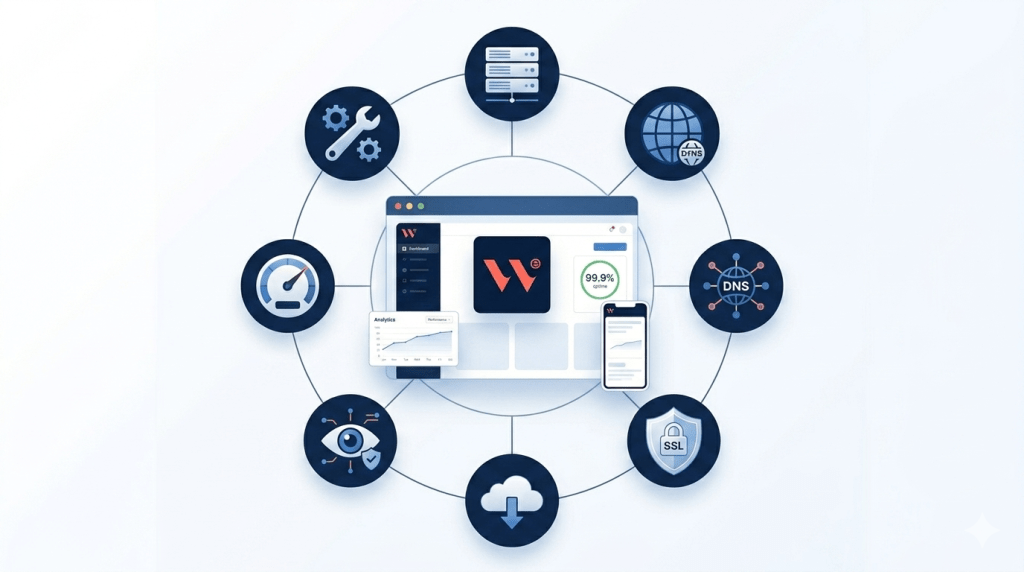
Hosting Setup and Optimization
We start by matching the hosting tier and architecture to your traffic, business model, and growth plans. Then we tune PHP versions, memory limits, caching layers, and database settings so the server runs efficiently from day one — not at defaults that work for nobody in particular.
Domain Lifecycle Management
Every domain has a lifecycle: registration, renewal, transfer, expiry. We track each step centrally, set multi-year renewals where appropriate, and verify ownership records. As a result, your domains can never be quietly lost, hijacked, or auctioned away due to a missed email.
DNS Configuration
Clean DNS is the difference between a stable site and mysterious outages. We document every record, test changes in staging where possible, and maintain separate, well-labeled routes for web traffic, email, and third-party integrations.
SSL Management
SSL certificates protect customer data and signal trust to browsers and Google. Therefore, we deploy modern certificates, automate renewals, and monitor expiration windows so visitors never see a “not secure” warning on your site.
Backups and Recovery
Backups are stored off-server, encrypted, and tested. Moreover, we run periodic restore drills so we know — not assume — that recovery actually works when it matters. A backup that has never been restored is, in practice, untested code.
Security Monitoring
We monitor logins, file integrity, server logs, and known vulnerability feeds. Consequently, suspicious activity is caught and contained before it becomes a breach, and patches are applied on a tested cadence rather than reactively.
Performance Optimization
Caching layers, image delivery, CDN routing, and database tuning are refined as your traffic patterns evolve. Performance is treated as a moving target, not a launch-day setting that gradually decays as your site grows.
Ongoing Maintenance
Plugin updates, theme patches, PHP upgrades, and core software updates run on a tested cadence with rollback points in place. Therefore, your site stays current without surprise breakages from unsupervised overnight updates.
Together, these eight areas form the WPExtent approach to hosting and domain management — grounded in the principle that infrastructure should be invisible to your customers and reliable for your business.
Not sure where your website currently stands on these eight areas? We’re happy to take a calm, expert look at your setup and tell you honestly what’s working and what’s quietly costing you uptime, speed, or rankings.
Frequently Asked Questions
What is hosting and domain management?
It refers to the technical operations that keep your website online and reachable — including server hosting, domain registration, DNS records, SSL certificates, backups, security, and ongoing maintenance handled as one coordinated effort rather than scattered tasks.
Why is hosting important for SEO?
Search engines reward fast, stable, secure sites. Slow servers, frequent downtime, and SSL errors all hurt rankings, while reliable hosting supports better crawl rates and stronger Core Web Vitals scores.
Can I manage hosting myself?
Technically, yes. However, the time, expertise, and continuous monitoring required typically exceed what most business owners can sustain — especially once a site begins generating meaningful revenue or carries customer data.
What happens if a domain expires?
Your website and email go offline immediately. After a short grace period, the domain becomes available for auction, and recovery can become expensive or, in some cases, impossible.
Do I need professional hosting support?
If your website matters to revenue, leads, or reputation, professional support usually pays for itself by preventing downtime, recovering from issues quickly, and keeping your infrastructure healthy long-term.
How often should backups run?
For active business sites, daily off-site backups are the baseline. Moreover, e-commerce and content-heavy sites often benefit from hourly or near real-time backup strategies with multiple restore points.
What’s the difference between web hosting and a domain name?
Hosting is the environment where your site lives — the server, storage, and software. A domain is the name people type to reach you, along with its DNS, email routing, and SSL. Both are essential, and they are usually best handled together.
How much does professional hosting and domain management cost?
It depends on traffic, complexity, and the level of monitoring required. However, most businesses find that a managed plan costs far less than a single hour of emergency recovery, a hacked-site cleanup, or a few hours of downtime during peak sales.
Can WPExtent migrate my existing website without downtime?
Yes. We plan migrations around your traffic patterns, stage everything in advance, and switch DNS in a controlled window so visitors and search engines experience the move smoothly.
Conclusion
A website is no longer something you build once and forget. It is a living system that needs continuous attention. Servers age, software updates, domains expire, threats evolve, and traffic patterns shift. Without ongoing care, even a great-looking site slowly becomes fragile, slow, and risky.
Hosting and domain management is the discipline that keeps that fragility under control. It blends technical monitoring, proactive maintenance, security awareness, and clear ownership. Furthermore, when handled properly, it disappears into the background — which is exactly how reliable infrastructure should feel.
For most businesses, the smartest move is not to learn everything themselves. Instead, it is to partner with a team that already does this work every day. As a result, you get fewer surprises, faster recovery when issues arise, and more time to focus on what actually grows the business.
This is the quiet role WPExtent plays for the brands we work with. We handle the servers, the renewals, the security, the performance, and the late-night alerts so business owners can focus on customers and growth. Moreover, we treat your infrastructure as an extension of your team — not a ticket queue to be closed.
If your website matters to your business, your infrastructure deserves the same attention you give your marketing. Whenever you’re ready, we’ll review your hosting and domain setup with you — clearly, honestly, and with no pressure to switch unless it genuinely helps.
Follow WPExtent for More Insights
Get practical WooCommerce tips, conversion strategies, and real-world insights to grow your online business.
We Are Available On:
Instagram:
https://www.instagram.com/thewpextent
Twitter (X):
https://x.com/TheWPExtent
Reddit:
https://www.reddit.com/user/WPExtent/


Leave a Reply