

Building a brand in 2026 is not what it used to be. Five years ago, a clean logo, a consistent color palette, and a few well-placed ads could carry a business a long way. Today, those basics are table stakes. They do not move the needle. They barely get you noticed.
The landscape has shifted so dramatically that many business owners who built strong brands in the past are now struggling to maintain that momentum. Meanwhile, new brands entering the market face a wall of noise, a skeptical audience, and a competitive environment shaped by technology they are still trying to understand.
This is not a doom-and-gloom article. However, it is an honest one. Before we talk about how to win at building a brand in 2026, we need to understand exactly what changed—and why so many businesses are getting it wrong.
The Reality Shift: What Changed and Why It Matters
A few years ago, visibility was the goal. Get in front of people, tell your story, repeat. It worked because the internet was still wide open, audiences were less fragmented, and trust was easier to earn. People gave brands the benefit of the doubt.
That era is over.
Today, audiences are bombarded with content from every direction. Social feeds are saturated. Inboxes are flooded. Every niche has dozens of competitors producing content at scale. In addition, thanks to AI tools, that scale has increased by an order of magnitude. Content is cheap. Attention is not.
The result is a trust deficit. People are more skeptical of brands than ever before. They question authenticity. They look for proof. They check reviews, compare websites, and decide within seconds whether a brand deserves their attention or not.
If your brand does not immediately signal credibility, clarity, and reliability, they move on. Therefore, building a brand in 2026 means understanding this shift at a fundamental level—not as a trend, but as the new permanent condition of doing business online.
Why Building a Brand in 2026 Is So Hard Now
The AI Content Flood Is Drowning Real Voices
There is a strange irony happening right now. AI tools have made content creation faster and cheaper than ever. However, they have also made content more generic. When everyone uses the same tools to produce blog posts, social captions, and product descriptions, everything starts to sound the same.
Audiences can feel it, even if they cannot name it. There is a flatness to AI-generated content that trained readers detect instinctively. And when a brand sounds flat, it feels untrustworthy—as though there is no real person behind it.
Therefore, the brands winning in 2026 are the ones that sound unmistakably human. They have a genuine perspective. They share real opinions. They write like they talk. That is not easy to manufacture. It requires actual thought and a clear brand voice that goes beyond a style guide.

Trust Is Now Earned in Milliseconds
When a potential customer lands on your website, they make a judgment call almost instantly. Research from Google and the Nielsen Norman Group shows it takes as little as 50 milliseconds for users to form a lasting first impression of a website. That is faster than a single blink.
In those milliseconds, they are not reading your copy. They are absorbing layout, speed, visual design, and overall feel. A slow-loading page, a cluttered layout, or an outdated design tells them everything they need to know: this brand is not professional enough to earn my trust.
This is why website performance is no longer a technical detail. It is a brand statement. Every second of delay, every broken element, and every jarring mobile experience actively erodes the credibility you spent money building through ads, content, and outreach.
Most Brands Are Inconsistent Without Realizing It
Ask most business owners whether their brand is consistent, and they will say yes. Then look at their Instagram page, their homepage, their email newsletter, and their customer service responses. In almost every case, they tell four slightly different stories.
Inconsistency is one of the silent killers of brand equity. It is not that people consciously notice the mismatch. Rather, they simply never form a clear picture of what the brand stands for. And a brand that is hard to define is a brand that is hard to remember, hard to recommend, and even harder to trust.
Building a brand in 2026 means being obsessively consistent: same tone, same values, same visual identity, same promise across every single touchpoint. It sounds simple. In practice, however, it requires real discipline and a documented brand system that every team member actually follows.
Every Niche Is More Crowded Than It Looks
The barrier to entry for starting a business has never been lower. This is good for entrepreneurs. However, it is a serious challenge for branding. Whatever niche you operate in, the number of competitors has multiplied. Search any service category and you will find dozens of businesses offering something remarkably similar to what you offer.
Differentiation used to come from having a better product. Today, product parity is common. As a result, differentiation now comes from brand clarity, positioning, and the emotional experience you create around your offering. That is a harder thing to build, and most businesses have not yet made that mental shift.
The Hidden Cost of Weak Branding
Here is something most marketing conversations skip over: weak branding does not just fail to attract customers. It actively costs you money.
Consider paid advertising as a direct example. Imagine a business running Google Ads that drive consistent traffic to their website—but the site loads in over four seconds, the layout is cluttered on mobile, and the value proposition is buried below the fold. The ads perform reasonably on click-through rate. However, the conversion rate stays stubbornly low. The brand is spending significant budget to bring people to a digital front door that immediately undermines the promise made in the ad. That gap between expectation and experience is a direct, measurable cost of weak branding.
The same principle applies to content marketing. You can produce excellent content, but if the website it lives on is slow, difficult to navigate, or visually uninspiring, that content never converts. Traffic arrives and then leaves without engaging further.
Weak branding also damages word-of-mouth, which is still the most powerful growth channel for most businesses. People do not refer brands they cannot easily describe. When someone tries to recommend you and struggles to explain what makes you different, that referral fades before it gains any real momentum.
In short, investing in a strong brand is not a luxury. It is the single highest-leverage investment most businesses can make. Everything else becomes more effective when the brand foundation is solid.
The Shift from Visibility to Trust
For a long time, the primary goal of marketing was to be seen. Get your name in front of as many people as possible and the business would follow. That model still has value, but it is no longer sufficient on its own.
In 2026, visibility without trust is almost worthless. People encounter hundreds of brand names every single day. Most of them disappear from memory within minutes. On the other hand, the brands that stick are the ones that do something visibility alone cannot achieve: they earn genuine, lasting trust.
Trust is built through repeated, reliable experiences. It comes from a website that loads fast and works flawlessly. It comes from content that actually helps rather than just sells. It comes from the same brand voice showing up consistently, whether someone is reading your blog, your product page, or even your error message when something goes wrong.
The most important question you can ask about your brand right now is not whether people have heard of you. It is whether the people who have heard of you trust you enough to choose you, recommend you, and return to you. That is a fundamentally different bar to clear.
How to Build a Brand in 2026: Practical Strategies That Actually Work
Define a Clear Point of View, Not Just a Value Proposition
Most brand positioning statements sound like this: we deliver high-quality service with a focus on the customer. That tells nobody anything meaningful. It sounds like every competitor in your category.
A real point of view takes a stand. It says something specific about how you see your industry, what you believe is broken about it, and how you approach things differently. It is a little uncomfortable to write because it inevitably excludes some people. However, that discomfort is exactly what makes it effective. When you try to speak to everyone, you end up resonating with no one.
Start by asking: what does my brand genuinely believe that most competitors would not say out loud? That is the beginning of a real brand position—and the foundation of building a brand in 2026 that people actually remember.
Make Your Website Your Hardest-Working Brand Asset
Your website is not a brochure. It is the place where every other channel sends people. Social media, paid ads, search results, referrals: they all eventually point here. Therefore, the website has to earn the trust that every other channel worked hard to build.
That means it has to be fast. Not just reasonably fast—genuinely fast. Google’s Core Web Vitals data consistently shows that pages loading in under two seconds see significantly higher engagement and lower bounce rates. According to Google research, even a one-second delay in mobile load time can reduce conversions by up to 20 percent. Each additional second of load time is not a minor inconvenience. It is real revenue walking out the door.
It also means clean, purposeful design. Every element on the page should either build trust or guide the user toward a decision. Anything else is clutter that dilutes both.
Platforms like WPExtent are built around this exact idea—ensuring that WordPress websites are fast, technically stable, and capable of reinforcing brand trust at every interaction. When the infrastructure is handled at a high level, the business can focus its energy on strategy, positioning, and content rather than constantly troubleshooting technical problems that silently erode the user experience.
Create Content That Reveals Real Expertise
Given how much content exists, the only content worth creating is content that demonstrates genuine expertise or a distinct perspective. Not summaries of what everyone else has already said. Not listicles padded to hit a word count. Real insight drawn from real experience.
This kind of content builds authority over time. It signals to readers and search engines alike that there is a knowledgeable human behind this brand, not just a content calendar and a publishing schedule. Furthermore, it gives people something worth sharing—which remains the most organic form of brand growth available.
Invest in SEO as a Brand Signal, Not Just a Traffic Channel
SEO has changed significantly. It is no longer primarily about keywords and backlinks, though those still matter. In 2026, search engines evaluate experience, expertise, authority, and trustworthiness in ways that are increasingly sophisticated.
This means that good SEO and good branding are now effectively the same thing. A fast, technically sound website with authoritative content and a genuine online reputation ranks better than a keyword-stuffed page with a slow load time and no real credibility. Therefore, every investment you make in your brand is, in turn, an investment in your search visibility.
The brands that understand this are pulling ahead in organic search while their competitors continue chasing tactics that no longer work.
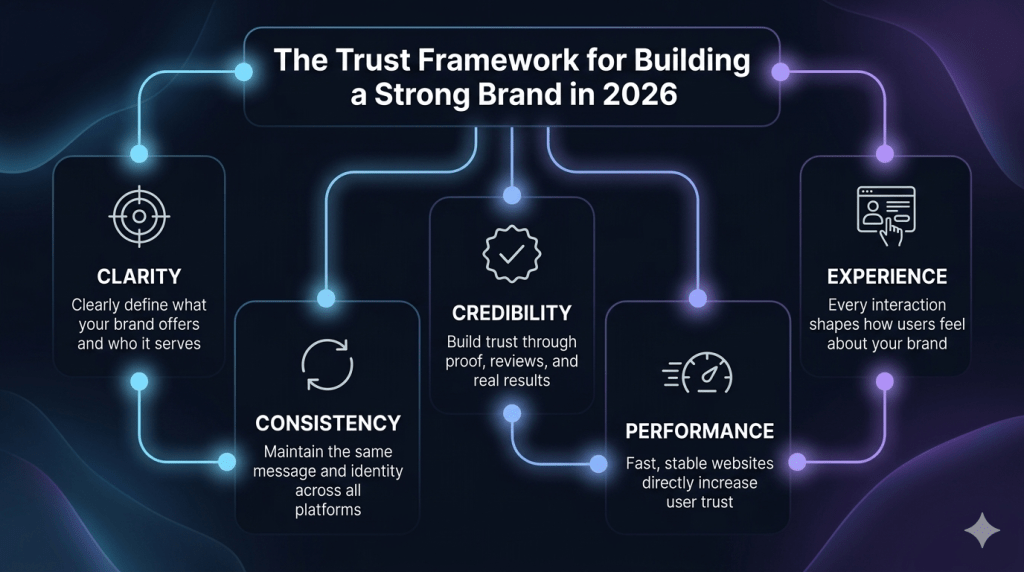
The Trust Framework for Building a Brand in 2026: Clarity, Consistency, Credibility, Performance, Experience
If you want a practical way to evaluate and strengthen your brand, think in terms of five interconnected pillars. Each one reinforces the others, and weakness in any single area weakens the whole.
- Clarity: Can someone who has never heard of you understand exactly what you do and who you serve within ten seconds of landing on your homepage? If not, you have a clarity problem that no amount of advertising will fix.
- Consistency: Does your brand show up the same way across every channel and every interaction? Small inconsistencies compound over time into a blurry, forgettable brand identity that no one feels confident recommending.
- Credibility: What proof does your brand offer that it can deliver on its promises? Reviews, case studies, credentials, affiliations, and the quality of your content all contribute to this in measurable ways.
- Performance: Does your digital presence actually work well? Site speed, uptime, mobile experience, and technical reliability are all brand attributes—whether you think of them that way or not.
- Experience: What does it feel like to interact with your brand? The emotional texture of each interaction—from reading a blog post to completing a checkout—shapes how people remember and talk about you.
The good news is that all five pillars are fully actionable. Each one can be audited, improved, and measured over time. Building a brand in 2026 is about systematically strengthening each of them rather than hoping that visibility alone will do the work.
WPExtent’s approach to WordPress performance is specifically designed to address the Performance and Experience pillars at a foundational level. By handling technical reliability, speed optimization, and site stability with precision, the platform frees businesses to direct their focus toward the pillars where strategic brand-building decisions actually live: Clarity, Consistency, and Credibility.
Frequently Asked Questions
Why is building a brand harder in 2026 than in previous years?
Several forces have converged to create this challenge. AI-generated content has flooded every channel, making it significantly harder to stand out through content volume alone. Consumer trust has declined across industries, so earning credibility requires more consistent effort and tangible proof. In addition, the number of competitors in almost every niche has grown dramatically. As a result, brands can no longer rely on visibility as their primary strategy. They now need to earn trust at every single touchpoint, and that requires a more disciplined and sophisticated approach than most businesses are currently applying.
How does website performance affect brand trust?
Website performance is a direct expression of brand quality. A slow, unreliable website signals to visitors that the brand is either unprofessional or simply does not care about user experience. Research consistently shows that users form strong first impressions within milliseconds, and much of that impression is based on how fast and smoothly the site loads. Poor performance increases bounce rates, reduces conversions, and undermines every other brand-building investment the business makes—from content to advertising to SEO.
Can small businesses realistically build strong brands today?
Absolutely. In fact, small businesses often have a natural advantage because they can be more authentic, more specific, and more genuinely human than large corporations. However, they need to be strategic about it. A small business cannot compete on reach or ad spend, so it needs to compete on clarity, credibility, and trust. A tightly defined niche, a fast and well-designed website, and consistent expert-level content can build a highly trusted brand without a large budget.
What role does SEO play in branding today?
SEO and branding are now deeply intertwined. Search engines, particularly Google, evaluate signals that align closely with brand trust: technical site quality, content expertise, user experience, and online reputation. A brand that invests in these areas improves both its search visibility and its overall market credibility. Conversely, a brand that neglects website performance or publishes low-quality content will struggle in both search rankings and consumer perception.
How do I know if my brand has a trust problem?
Some clear signals include high website bounce rates, low repeat visitor numbers, weak word-of-mouth referrals, and difficulty converting warm leads. A more diagnostic approach involves asking someone unfamiliar with your business to describe your brand based only on your homepage. If they struggle, or if their description does not match your intent, you have a clarity and trust problem worth addressing. Regular brand audits across all channels can reveal inconsistencies you have become too familiar with to notice on your own.
Where should I start if I want to improve my brand right now?
Start with your website. It is the one place where every other channel eventually sends people, and it is the clearest public expression of your brand’s professionalism and credibility. Audit your load speed, your mobile experience, and the clarity of your design. Then sharpen your core message. Make sure your value proposition is unmistakable within the first few seconds of a visit. Once those foundations are in place, everything else—content, social media, advertising—becomes significantly more effective and more efficient.
Final Thoughts: The Brands That Win in 2026 Are Built on Trust
Building a brand in 2026 is genuinely harder than it was before. The tools are more powerful, the competition is more intense, and the audience is more skeptical. These are not temporary challenges. They are the permanent new conditions of doing business in a hyper-connected, AI-accelerated world.
However, harder does not mean impossible. It means the brands that take it seriously have a real and significant advantage over those that do not. While competitors chase reach and volume, you can build something far more durable: a brand that people trust, remember, and return to without needing to be reminded.
Start with your foundation. Make your website fast, clear, and reliable. Establish a genuine brand voice. Be consistent across every channel. Produce content that actually demonstrates expertise. And measure trust, not just traffic.
The brands that win in 2026 will not be the loudest. They will be the most trusted. That is a goal worth building toward—and every deliberate step you take toward it compounds over time.
In a world where anyone can publish, the brands that win are the ones that consistently perform.
If you are ready to build on a foundation that supports that level of performance, it is worth exploring what platforms like WPExtent make possible—where speed, reliability, and technical excellence are not optional extras, but the baseline from which strong brands grow.
Follow WPExtent for More Insights
Get practical WooCommerce tips, conversion strategies, and real-world insights to grow your online business.
We Are Available On:
Instagram:
https://www.instagram.com/thewpextent
Twitter (X):
https://x.com/TheWPExtent
Reddit:
https://www.reddit.com/user/WPExtent/



Leave a Reply