

Picture this: You’re finally ready to take your small business online. You’ve got your business plan, you know your customers, and you’re excited about the possibilities. But then you start researching website platforms, and suddenly you’re drowning in options.
WordPress. Shopify. React. Wix. Squarespace. Everyone claims to be the best website platform for small business. Your developer friend swears by one, the internet says another, and your competitor seems to be doing just fine with something completely different.
Here’s the truth: there is no universally “best” platform. However, there is a best platform for your business. And choosing the right one isn’t just a technical decision—it’s a strategic business decision that will impact your growth, marketing, and bottom line for years to come.
In this comprehensive guide, we’ll cut through the noise and help you understand which website platform actually makes sense for
Why Choosing a Website Platform Feels So Overwhelming
If you’re feeling confused about website development for small business, you’re not alone. The confusion isn’t your fault—it’s built into how this industry works.
First, every platform claims to be the best. They all have impressive case studies, beautiful templates, and promises of easy setup. Of course they do—they want your business.
Second, most developers recommend what they know best. A WordPress developer will pitch WordPress. A Shopify expert will push Shopify. They’re not necessarily being dishonest, but they’re naturally biased toward their area of expertise.
Third, online comparison articles are often sponsored or affiliate-driven. Many “unbiased” reviews are actually trying to funnel you toward specific platforms because that’s where the commission is.
Finally, as a business owner, you’re probably not sure what truly matters. Is it the number of themes available? The monthly price? The technical capabilities? How do you even compare these things when you don’t speak the language?
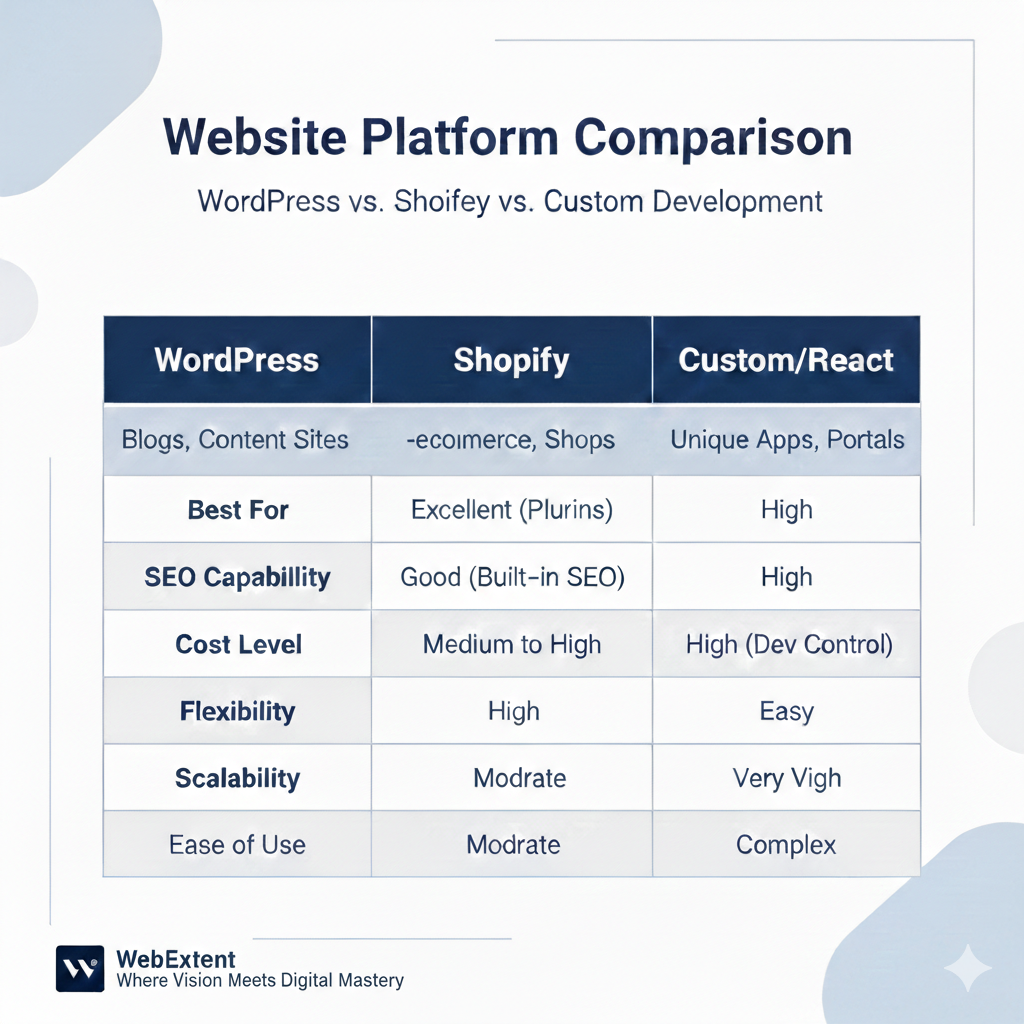
Understanding Your Options: Platform Comparison
Let’s break down the three main platforms small businesses consider, without the marketing fluff. Each has genuine strengths and real limitations.
WordPress: The Flexible Powerhouse
WordPress powers over 40% of all websites on the internet, and there’s a reason for that dominance. It’s incredibly flexible, highly customizable, and can grow with your business from day one to enterprise scale.

The biggest advantage? Complete control and ownership. Your website, your data, your rules. WordPress is open-source, which means you’re not locked into a proprietary system. If you ever want to switch developers or hosting, you can do it without rebuilding from scratch.
From an SEO perspective, WordPress is unmatched. Therefore, if organic search traffic is important to your business strategy (and it should be), WordPress gives you every tool you need to rank well. You can optimize every element, create content-rich blogs, build internal linking structures, and integrate with any marketing tool you can imagine.
Cost-wise, WordPress offers excellent value. The software itself is free. You pay for hosting, themes, and plugins, but you have complete control over these expenses. Want to start lean and scale up? You can. Need enterprise-level features later? They’re available.
WordPress works best for:
Service-based businesses (consultants, agencies, professionals)
Content-driven websites that rely on blogging and SEO
Businesses that plan to scale and need flexibility
Organizations that want full ownership and control
However, WordPress does require more technical maintenance than some alternatives. You’ll need someone who understands updates, security, backups, and optimization—either in-house or through a reliable development partner.
Shopify: Built for Online Selling
If you’re selling physical products online, Shopify deserves serious consideration. It’s purpose-built for eCommerce, which means everything you need for online retail is built in and optimized from day one.
Inventory management, payment processing, shipping calculations, abandoned cart recovery, product variations—all of this works out of the box. Because Shopify is a hosted platform, they handle the technical heavy lifting: security, hosting, updates, and compliance are managed for you.
The user interface is genuinely intuitive. You can add products, manage orders, and update your store without touching code. For small business owners who want to focus on selling rather than managing websites, this simplicity is valuable.
The trade-off? You’re renting, not owning. Shopify is a subscription service, typically starting around $29-$79 per month, plus transaction fees if you don’t use Shopify Payments. Over time, these costs add up, and you’re perpetually dependent on their platform.
Customization is more limited than WordPress. While you can modify your Shopify store, you’re working within their ecosystem and constraints. Complex customizations often require Shopify-specific developers, which can be expensive.

Shopify makes sense when:
You’re primarily selling physical products
You want a managed, all-in-one eCommerce solution
You need to launch quickly without technical complexity
The monthly fees and transaction costs fit your business model
For businesses that are part eCommerce and part content/service, the decision between WordPress vs Shopify for small business often comes down to your primary revenue source. If products are your main business, Shopify. If services and content drive your business with some products on the side, WordPress with eCommerce plugins often makes more sense.
React and Custom Development: When You Need Something Unique
React isn’t really a website platform like WordPress or Shopify—it’s a JavaScript library used to build custom web applications. When people ask about React vs WordPress website options, they’re usually asking whether they should use a platform or build something completely custom.
Custom development with React (or similar modern frameworks) gives you unlimited possibilities. Your website can do literally anything you can imagine and code. The user experience can be exactly what you envision, with no compromises or workarounds.
Performance can be exceptional. A well-built React application loads fast, feels responsive, and provides an app-like experience that impresses users. For certain types of businesses, this performance advantage directly translates to better conversion rates and user satisfaction.
The reality check? Custom development is expensive and requires ongoing technical expertise. Instead of thousands of dollars, you’re looking at tens of thousands for proper custom development. Moreover, you’ll need developers not just to build it, but to maintain and update it over time.
Content updates that would be simple in WordPress require developer time in custom applications. Want to add a blog post? You might need a developer. Want to change a form? Developer. This dependency can slow down your business and increase operational costs.
Custom React development makes sense for:
SaaS platforms and web applications
Businesses with complex, unique functionality requirements
Projects where performance and user experience are make-or-break
Companies with substantial development budgets and ongoing technical resources
For most small businesses in their first few years, custom development is overkill. The investment rarely provides enough additional value to justify the cost, especially when platforms like WordPress can be customized to meet 95% of your needs at a fraction of the price.
How to Choose the Right Website Platform for Your Business
Now that you understand the landscape, let’s make this practical. The right platform for you depends on specific factors about your business, not on which platform is “best” in the abstract.
Ask yourself these strategic questions:
1. What’s your primary business model?
If you’re primarily selling physical products, Shopify or WordPress with WooCommerce are strong options. Service-based businesses typically benefit most from WordPress. For SaaS platforms or complex applications, custom development is usually the better choice.
2. How important is content marketing and SEO to your strategy?
If organic traffic and content are central to how you acquire customers, WordPress is typically the strongest choice. It gives you complete control over SEO and makes publishing content straightforward.
3. What’s your realistic budget—both initial and ongoing?
Be honest about what you can afford not just to build, but to maintain. A $3,000 WordPress site might cost $100-300/month to maintain. A Shopify store might cost $50-150/month in platform fees alone. Custom development could require $3,000-10,000+ annually in developer time.
4. How quickly do you need to launch?
Shopify can get you live fastest for eCommerce. WordPress is quick for content sites. Custom development takes months. Sometimes getting a good-enough solution live quickly beats waiting for the perfect custom solution.
5. What’s your growth plan for the next 3-5 years?
Will you add services? Products? Locations? Team members? Your platform should support your growth without requiring a rebuild. WordPress excels here because of its flexibility.
6. Do you have technical resources in-house?
If you have a technical team member or reliable development partner, you have more options. If you’re completely on your own, managed platforms like Shopify might reduce stress and headaches.
7. How unique are your requirements?
Most small businesses have fairly standard needs: show services, accept inquiries, maybe sell products, publish content. If your needs are standard, use a platform. If you genuinely need something no platform can provide, then explore custom development.
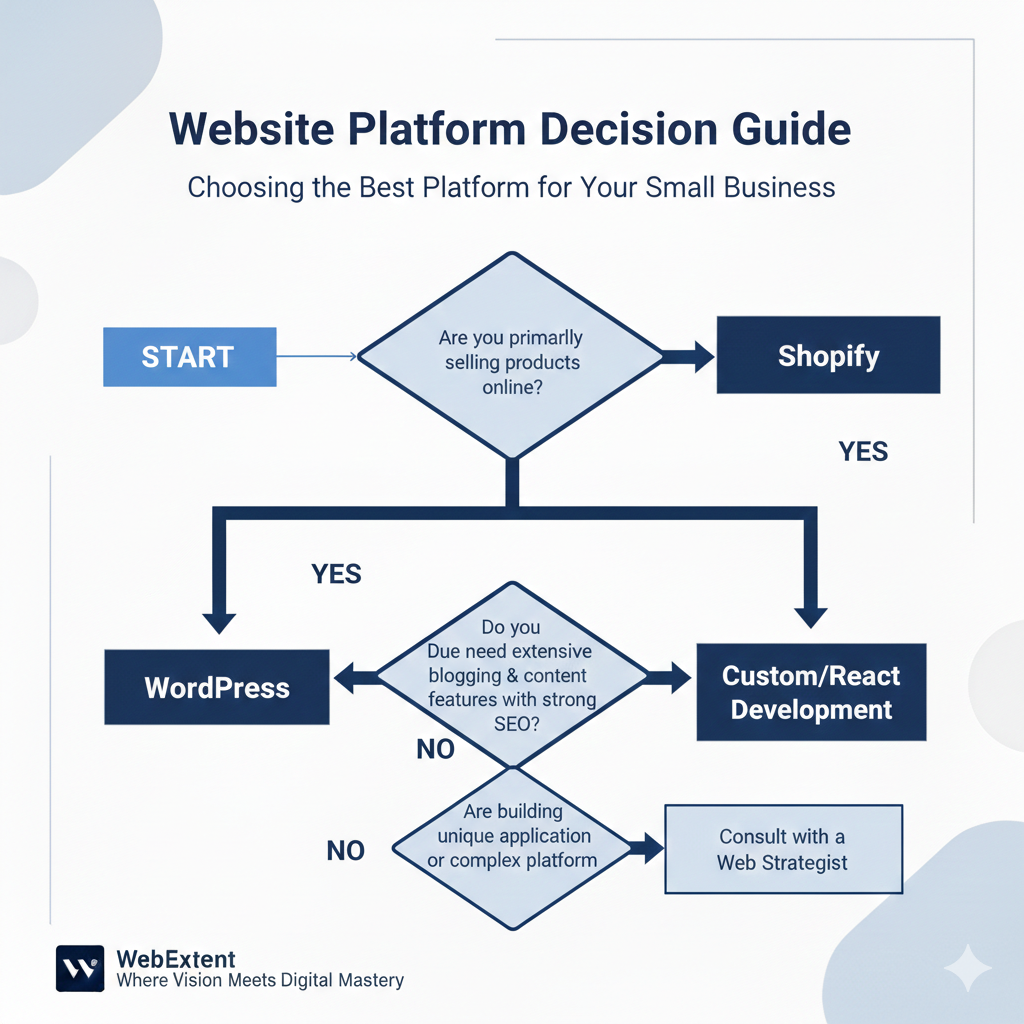
Why Your Platform Choice Is a Strategic Business Decision
Here’s what many small business owners don’t realize: your website platform isn’t just about how your site looks or works today. It fundamentally affects your business’s ability to grow, market effectively, and compete online.
Platform affects SEO performance. Search engines rank websites based on hundreds of factors. Your platform determines how easily you can optimize for these factors. Some platforms make SEO natural and straightforward. Others make it difficult or impossible to implement best practices.
It impacts long-term marketing costs. If your platform makes organic search difficult, you’ll spend more on paid advertising forever. If content marketing is hard, you’ll struggle to build authority in your industry. The right platform can reduce your customer acquisition costs by 50% or more over time.
Platform determines maintenance costs. A well-chosen platform that fits your needs will cost less to maintain. A poor fit requires constant workarounds, custom development, and technical patches—all expensive.
It influences scalability. Can your platform handle 10x traffic? 100x? Can you add new features without rebuilding? Some platforms scale effortlessly. Others hit walls that force expensive migrations later.
Platform affects conversion rates. Page speed, user experience, mobile optimization, checkout processes—all influenced by your platform choice. A one-second delay in load time can reduce conversions by 7%. Over a year, that might be thousands or millions in lost revenue.
This is why choosing a website platform shouldn’t be about finding the cheapest option or the one with the prettiest templates. It should be about finding the platform that best supports your business strategy and growth plans.
Why This Matters More Than the Technology Itself
At WebExtent, we’ve built hundreds of websites on different platforms for small businesses. Here’s what we’ve learned: the platform matters, but the strategy matters more.
We don’t have a default platform we push on every client. Instead, we start by understanding your business goals. Where do you want to be in three years? How do you acquire customers? What’s your competitive advantage? What resources do you have available?
Only then do we recommend a platform—and we explain exactly why it fits your situation. Sometimes that’s WordPress. Sometimes it’s Shopify. Occasionally it’s custom development. The recommendation is based on ROI and strategic fit, not on what’s easiest for us to build.
Moreover, we don’t just build websites and disappear. We think of ourselves as long-term digital partners. Your business will evolve. Your needs will change. Technology will advance. We’re here to help you adapt, optimize, and grow—not just at launch, but for years afterward.
This means:
Strategic consultation before development. We analyze your growth roadmap and competitive landscape before recommending solutions.
Integrated approach. We don’t just think about code—we integrate SEO, content strategy, conversion optimization, and user experience from day one.
ROI focus. We recommend solutions that will generate measurable business results, not just look impressive.
Ongoing support and optimization. Technology and best practices evolve. We help you stay current and competitive.
Education and transparency. We explain things in plain English and help you understand the implications of technical decisions.
The website platform you choose is important. But even more important is having a strategic partner who understands how that platform serves your business goals and can help you maximize its potential over time.
Frequently Asked Questions
What is the best website platform for small business?
There’s no universal “best” platform—it depends on your specific needs. WordPress is typically ideal for service-based businesses and content-driven sites. Shopify works well for product-based eCommerce. Custom development suits unique applications with substantial budgets. The best choice aligns with your business model, budget, and growth strategy.
Is WordPress better than Shopify?
WordPress and Shopify serve different primary purposes. WordPress offers more flexibility, better SEO capabilities, and lower long-term costs, making it better for content and service businesses. Shopify provides superior built-in eCommerce features and easier management for product-focused businesses. Neither is universally better—choose based on whether content or commerce is your primary focus.
Is React good for small businesses?
React is excellent for custom web applications but often overkill for typical small business websites. It requires significant development investment and ongoing technical resources. Most small businesses get better ROI from platforms like WordPress that balance customization with cost-effectiveness. Consider React only if you have unique functionality needs and substantial budget.
How much does a small business website cost?
Costs vary widely based on platform and complexity. Basic WordPress sites start around $2,000-5,000. Shopify stores typically range from $3,000-10,000. Custom development starts at $10,000+. Additionally, budget for ongoing costs: hosting ($10-100/month), maintenance ($100-500/month), and platform fees if applicable. Quality development is an investment that generates returns through better performance and conversion.
Should I hire a web development agency?
Professional development typically provides better ROI than DIY solutions for serious businesses. Agencies bring strategic expertise, technical knowledge, design skills, and SEO understanding that directly impact results. However, choose an agency that acts as a strategic partner—one that understands your business goals first and recommends appropriate solutions rather than pushing a one-size-fits-all approach.
Making Your Decision With Confidence
Choosing the best website platform for small business doesn’t have to be overwhelming once you understand that the “best” platform is simply the one that best serves your specific business goals.
WordPress offers unmatched flexibility and SEO power for content and service businesses. Shopify provides streamlined eCommerce management for product sellers. Custom development delivers unique solutions when you have complex needs and resources to match.
Remember, this isn’t just a technical decision—it’s a strategic business decision that affects your marketing, growth, and bottom line. The right platform should support your business strategy, not constrain it.
If you’re still unsure which direction makes sense for your business, that’s completely normal. The smartest first step is strategic consultation with someone who understands both the technology and the business implications.
At WebExtent, we help small businesses make these decisions every day. We’d be happy to discuss your specific situation, analyze your needs, and recommend the approach that offers the best ROI for your goals—with no pressure and no sales pitch, just honest strategic guidance.
Ready to build a website that actually drives business growth? Get in touch with WebExtent for a strategic consultation. Let’s figure out the right platform for your business together.
Subscribe to Us on YouTube
Get exclusive tutorials, behind-the-scenes content, and expert insights delivered directly to your feed.
We are available on:
Facebook: https://facebook.com/webextent.net/
Instagram: https://www.instagram.com/webextentofficial/
Twitter: https://twitter.com/WebExtent
Welcome to the new WebExtent. Welcome to digital excellence.
Where Vision Meets Digital Mastery
End-to-End Digital Solutions. Designed to Impress, Built to Perform.


Leave a Reply