

Introduction: Something Changed, and Most Freelancers Didn’t Notice
The work gets done. It gets delivered on time. And it often goes beyond what the client expected. Yet in 2026, freelancers losing clients has quietly become a growing struggle—even when the quality of work has not declined.
And still—they didn’t come back. Or they went quiet after the proposal. Or you looked at your pipeline one morning and realized it had silently dried up.
If this sounds familiar, you are not alone. Freelancers losing clients in 2026 is not just a personal struggle—it is a widespread, quiet crisis affecting thousands of talented WordPress developers, designers, and digital agencies worldwide. And the unsettling part? Most of them have no idea why it is happening.
This is not about working harder. It is not about lowering your prices. And it is absolutely not about your skills being insufficient.
The rules of the game changed—while many freelancers and agencies were still playing by the old ones.
Let’s break down exactly what is going on. And more importantly, let’s talk about what you can do to turn things around.
The Reality Shift: How Clients Think in 2026
Not long ago, a strong portfolio and solid word-of-mouth were enough. Clients came to you, liked your work, and hired you. Simple.
That world still exists—but it is shrinking fast.
Today’s clients enter every conversation already prepared. They’ve Googled you, read your reviews, and compared multiple competitors before sending a single message. In some cases, they even use AI tools to draft project briefs and estimate pricing before ever reaching out.
Client behavior has shifted in three fundamental ways:
- They expect faster responses and clearer communication than ever before.
- They evaluate your professionalism through how your process feels, not just your portfolio.
- They have become more comparison-driven—trust is earned faster, but lost even faster.
The traditional cycle of posting on LinkedIn, hoping for referrals, and sending cold emails no longer produces consistent results. Clients want proof, clarity, and confidence before writing you a check.
Why Freelancers Losing Clients Is Increasing in 2026
Losing clients rarely comes from a single catastrophic failure. More often, it is a slow accumulation of small cracks. These fall into three categories.

Surface-Level Mistakes
These are the visible problems that a quick audit can reveal:
- Slow response times. Clients test your responsiveness before hiring you. If you take 48 hours to reply to a prospect, they have already moved on.
- Confusing proposals. If a client reads your proposal and still does not know exactly what they are getting, they default to whoever made it clearest.
- A portfolio that does not speak to their problem. Showing your best design work to a client who needs a fast WooCommerce store is misaligned—not impressive.
Strategic Mistakes
These run deeper and are harder to spot:
- Competing on price. When you lower your rates to win work, you attract clients who will always look for someone cheaper. It is a race you cannot win.
- Positioning as a generalist. “I do websites, SEO, logos, and social media” sounds versatile. To clients, it reads as unfocused.
- No clear niche or authority signal. Clients hire people they trust to solve a specific problem. Without clear positioning, you blend into the background.
System-Level Failures
This is where most freelancers and agencies truly lose ground—not in skills, but in structure:
- No consistent follow-up process after proposals
- No lead nurturing system between projects
- No testimonial or case study collection process
- No onboarding experience that builds immediate client confidence
➤ The real truth: talent without a system is inconsistency waiting to happen.
Hidden Mistakes That Go Unnoticed (But Clients Always Feel)
Some of the most damaging client mistakes happen silently. You don’t get a warning. You just get silence.
Communication Gaps
Clients do not just want work delivered—they want to feel informed throughout. When they hear nothing for a week mid-project, anxiety builds. And anxious clients do not return.
A simple weekly update—even a two-sentence email—can dramatically change how clients feel about working with you. However, most freelancers skip this step entirely.
Lack of Proof at Decision Points
A testimonial buried on a page nobody reads does nothing. Clients want relevant social proof at every decision point—on your homepage, inside your proposals, and in your follow-up emails.
Think about it this way: if someone is deciding whether to hire you, show them a story from someone just like them who got real results.
No Follow-Up System
Here is a painful truth: most clients do not say no—they simply get distracted. A polished proposal sent once and never followed up is, statistically, a lost deal.
A simple three-to-four message follow-up sequence over two weeks can recover a meaningful percentage of “silent” proposals. Therefore, the absence of this alone is costing most freelancers thousands of dollars per year.
Selling Services Instead of Outcomes
“I build WordPress websites” does not sell. “I help local businesses go from invisible to booked-out in 90 days using a conversion-optimized WordPress site”—that sells.
The difference is not just wording. It is a fundamental shift in positioning. Clients buy outcomes, not deliverables.
How AI Is Influencing Client Decisions
Let’s talk about AI—not with fear, but with clarity.
AI has not made great freelancers irrelevant. However, it has changed how clients think about value, speed, and communication. And those who ignore this shift are feeling it in their pipelines.
Clients Use AI to Research and Compare You
Before reaching out, many clients now use AI tools to generate comparison lists, research agencies, and understand what “good” looks like in their industry. If your online presence is thin or unclear, AI-powered searches surface your competitors instead of you.
AI Has Raised the Baseline Expectation
When clients can get a decent first draft in minutes, their tolerance for slow, vague, or generic work drops significantly. As a result, your value must now live in what AI cannot do—strategic thinking, empathy, customization, and long-term relationship building.
AI Creates Opportunity for the Prepared
Additionally, clients who have tried AI tools and found them frustrating are actively seeking skilled humans who can guide the process. This is an open door for freelancers and agencies who position themselves as strategic partners, not just service providers.
“AI isn’t replacing freelancers—it’s revealing who is replaceable.”
The freelancers thriving right now are not fighting AI—they are using it to streamline their systems and reserve their best thinking for client relationships.
The Real Problem: Lack of Systems
Here is what most freelancers and agencies eventually realize: the problem is not capability. You are talented. The problem is inconsistency—and inconsistency is almost always a system problem.
In busy periods, marketing is often neglected. After completing a project, many freelancers suddenly shift into “finding the next client” mode. When clients go quiet, it usually exposes the absence of any follow-up system. And even referrals lose impact when the onboarding experience does not feel structured or intentional.
That feast-and-famine cycle is not a reflection of your talent. It is a reflection of the infrastructure behind your business.
No system = inconsistency | System = predictability
[Internal Link: WordPress Business Systems]
Systems replace scrambling. They create consistency. And consistency is what clients feel—even when they cannot explain why they trust one agency over another.
Practical Solutions: Build a Client Acquisition System That Works
Here are the building blocks of a freelance or agency system that creates consistent, growing client flow. Moreover, each step builds on the one before it.
Step 1: Nail Your Positioning
Choose a specific niche and the exact problem you solve. You do not need to turn away every other client—but your messaging must speak to one ideal client clearly. The more specific you are, the more magnetic you become.
Example: Instead of “WordPress developer,” try “I help health and wellness brands launch fast, SEO-optimized WordPress sites that turn visitors into appointments.”
Step 2: Build Authority Before You Need It
Publish content that solves your ideal client’s real problems. Write case studies. Share behind-the-scenes work. Offer a free resource—a checklist, a guide, a template—that demonstrates your expertise.
Authority is not built overnight. However, every piece you publish compounds over time.
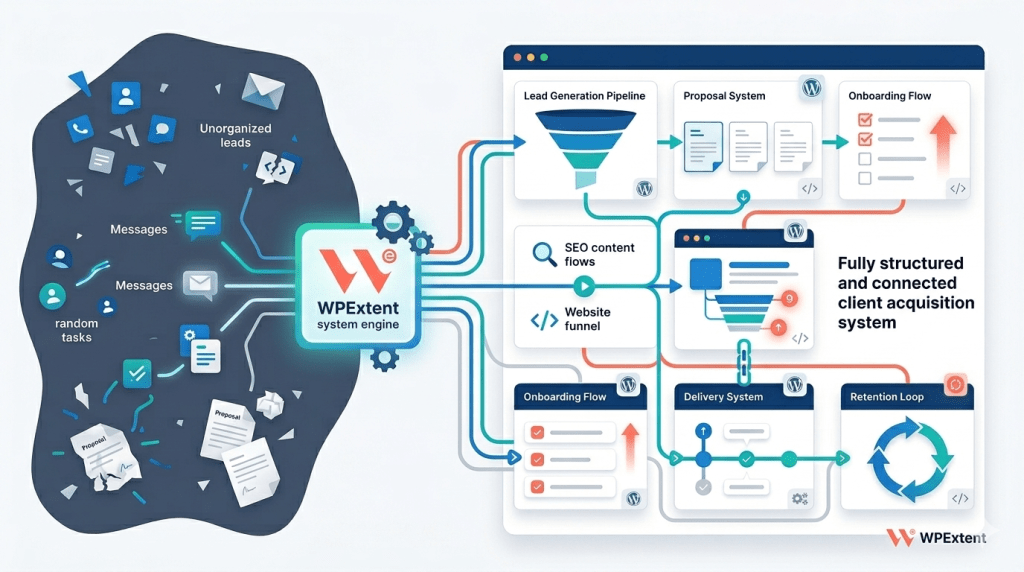
Step 3: Create a Lead Generation Engine
Stop relying on word-of-mouth alone. Build one primary lead channel—whether that is organic SEO content, LinkedIn outreach, or a niche directory listing—and work it consistently for 90 days before judging results.
[Internal Link: WordPress SEO Content System]
Step 4: Build a Conversion System
Your conversion system includes: a clear service page with outcome-focused copy, a proposal template that feels like a confident roadmap, a follow-up sequence of three to four messages, and social proof at every decision point.
When someone enters your world, they should feel guided—not left to figure things out on their own.
Step 5: Deliver in a Way That Generates Referrals
Onboarding, regular check-ins, a polished delivery presentation, and a 30-day post-launch review are not extras—they are part of your product. Clients who feel genuinely cared for do not just come back. They talk about you.
How WPExtent Fits Into Your Growth Story
If you are building or growing a WordPress-based freelance or agency business, you need more than good intentions. You need tools, guidance, and a community that understands your specific challenges.
That is where WPExtent comes in—not as a vendor, but as a growth partner.
WPExtent exists to help WordPress professionals work smarter. Whether you are looking for plugin resources, SEO strategies, or actionable business insights tailored to the WordPress ecosystem, WPExtent is built around one idea: your success should be systematic, not accidental.
Think of WPExtent as the infrastructure layer for your WordPress business—a library of resources and a community that helps you build systems, not just sharpen skills. WPExtent helps turn WordPress sites into client-generating systems that work even when you are not actively hustling.
Frequently Asked Questions
1. Why are freelancers losing clients more often in 2026?
Freelancers are losing clients primarily because client expectations have evolved faster than most freelancers’ business systems. Clients now research thoroughly before hiring, compare multiple options, and expect professional communication and clear outcomes—not just good work. Additionally, AI tools have raised the baseline for speed and quality, making gaps in positioning and process much easier to spot.
2. How can I stop losing clients and improve retention?
Client retention improves when you focus on the experience, not just the deliverable. Set clear expectations upfront, communicate proactively during projects, and follow up after delivery. A simple check-in email 30 days post-launch can reopen conversations and generate referrals. Retention is a system, not a one-time effort.
3. How is AI changing client decisions for freelancers?
AI has changed client acquisition by making clients more informed and comparison-ready before they ever reach out. It has also raised expectations around turnaround time and communication clarity. However, AI creates opportunity for freelancers who use it strategically—to automate admin tasks, personalize outreach, and free up time for relationship-building.
4. How do I build a client acquisition system as a freelancer?
A basic client acquisition system has four parts: a clear niche and positioning, consistent authority-building content, one reliable lead generation channel (SEO, LinkedIn, or referrals), and a conversion process that includes a strong proposal, follow-up sequence, and smooth onboarding. Build these in order and work each stage for at least 90 days before evaluating results.
5. What are the most common mistakes agencies make that cause client churn?
The most common agency mistakes include: vague positioning that does not connect with client problems, proposals that focus on services rather than outcomes, poor communication during projects, no follow-up system after proposals go quiet, and a lack of documented processes that make the client experience feel inconsistent.
6. How can WordPress freelancers get more clients consistently?
WordPress freelancers get consistent clients by combining three things: a niche-specific online presence (optimized website and case studies), a lead generation channel they commit to for 90 days, and a conversion system that moves prospects from inquiry to signed contract smoothly. Platforms like WPExtent provide resources and strategies specifically designed for this ecosystem.
7. Is it possible to compete with AI as a freelancer in 2026?
Absolutely—and the best freelancers are not competing with AI; they are collaborating with it. AI handles repetitive tasks while you handle strategy, relationships, and creative judgment. The freelancers losing ground are those who have not adapted their value proposition. Those thriving position themselves as strategic partners who use AI as a tool.
8. How long does it take to build a consistent client pipeline?
With a focused system, most freelancers and agencies begin seeing consistent results within 90 to 120 days. The key is committing to one lead channel, showing up consistently, and refining your positioning based on what resonates. Consistency always outperforms intensity in client acquisition.
Conclusion: Stop Hustling Harder. Start Building Smarter.
If you have been feeling frustrated, confused, or stuck in a cycle of inconsistent clients, hear this clearly: there is nothing wrong with you.
The world around your business has changed. Client expectations have evolved. AI has raised the baseline. And the old approach of “just do good work and clients will come” no longer works on its own.
But here is what is also true: freelancers and agencies who build real systems—clear positioning, consistent authority, smart follow-up, and genuine client care—are growing faster in 2026 than at any point before.
The gap between those who struggle and those who thrive has almost nothing to do with talent. It has everything to do with structure.
So stop trying to work harder in the wrong direction. Build the system. Then let the system do the heavy lifting.
You’ve got this—now go build it.
Follow WPExtent for More Insights
Get practical WooCommerce tips, conversion strategies, and real-world insights to grow your online business.
We Are Available On:
Instagram:
https://www.instagram.com/thewpextent
Twitter (X):
https://x.com/TheWPExtent
Reddit:
https://www.reddit.com/user/WPExtent/


Leave a Reply