
You’ve done everything right on the surface. Your website looks professional, your content is solid, and you’re investing in SEO — but if Website Architecture SEO isn’t properly implemented, your results will always hit a ceiling. Your rankings barely move. Traffic stays frustratingly flat. Meanwhile, competitors with less polished websites continue to outrank you on Google.
Here’s the uncomfortable truth most agencies won’t tell you: website architecture SEO is often the real reason behind stagnant rankings. It’s the invisible foundation of your site — the structure that either strengthens every piece of content you publish or silently weakens your entire SEO strategy.
In 2026, Google’s algorithms are more advanced than ever. They don’t just scan for keywords anymore. They analyze topics, context, relationships between pages, and how your content connects across your site. If your structure isn’t strategically designed to support that level of understanding, even great content and strong backlinks won’t deliver the growth you expect.
In this guide, you’ll learn exactly what website architecture SEO is, why it remains one of the most overlooked growth drivers in digital marketing, and how to build a strategic site structure that produces sustainable, long-term rankings.
What Is Website Architecture SEO?
Most people think of a website as a collection of pages. But from a search engine’s perspective, a website is a structured system — a network of interconnected content with a clear hierarchy, logical navigation, and strategic internal links. Website architecture SEO is the practice of designing that system intentionally, with rankings and user experience built in from the ground up.
Think of it like constructing a commercial building. Before a single wall goes up, an architect drafts a blueprint — mapping every floor, corridor, room, and exit. Skip the blueprint, and you end up with a structure that’s difficult to navigate and impossible to expand. Your website works exactly the same way.
Understanding Website Hierarchy Structure
A website hierarchy structure defines the relationship between your pages. At the top sits your homepage, followed by main category pages, then subcategory pages, and finally individual content pages. A clear hierarchy tells Google which pages are most important and how content is related.
A well-designed hierarchy might look like this: Home → Services → Web Design → E-Commerce Website Design. Each level adds specificity, and the structure makes logical sense for both users and crawlers.
URL Structure and Its Role in Website Architecture SEO
Your URLs are more than web addresses — they’re signals. A clean URL like `/services/seo-website-audit/` tells Google precisely what a page is about. In contrast, `/page?id=47&cat=3` communicates nothing. As part of your website architecture SEO, every URL should be short, descriptive, keyword-rich, and free of unnecessary parameters.
Navigation and Crawl Depth in SEO Site Structure
Navigation is the visible expression of your SEO site structure. It guides users through your website and signals to Google which pages matter most. Crawl depth — the number of clicks required to reach a page from the homepage — directly influences how often Google visits and ranks that page. Pages buried five or six clicks deep are frequently ignored by crawlers entirely.
The goal of a strong SEO site structure is to keep every important page within two to three clicks of the homepage.
Internal Linking Strategy as the Core of Website Architecture SEO

If website hierarchy is the skeleton, your internal linking strategy is the circulatory system. Internal links move authority (also called link equity) from strong pages to weaker ones, connect related content, and guide crawlers through your site efficiently. Without a deliberate linking strategy, authority pools in your homepage and never flows to the pages that need it most.
Why Website Architecture SEO Matters More in 2026
According to Ahrefs, 90.63% of pages receive zero organic traffic from Google. In many cases, poor site structure — not lack of content — is the primary reason.
Google’s algorithm updates over the past few years have fundamentally changed what it means to rank. The search engine now evaluates topical authority, semantic relationships, and entity understanding — not just individual keywords. A website with strong website architecture SEO is built to communicate all of this clearly.
Here’s why the stakes are higher than ever in 2026.
Crawlability and Efficient Indexing
Google allocates a ‘crawl budget’ to every website — a limit on how many pages it will crawl in a given period. A disorganised site wastes that budget on duplicate content, parameter URLs, and irrelevant pages, while your most valuable content goes unvisited. A logical architecture ensures crawlers spend their budget where it matters.
Authority Flow and Ranking Power
Every backlink your site earns passes authority inward. Where that authority flows next is determined by your internal linking structure. A well-planned architecture channels authority from your homepage and high-traffic pages directly to service and product pages — the ones you need to rank.
User Behaviour Signals
Google tracks user behaviour: how long people stay on your site, how many pages they visit, and whether they return to search results (a signal called ‘pogo-sticking’). A confusing site structure sends visitors away quickly, sending Google a negative quality signal. A logical, intuitive structure keeps users engaged — which reinforces your rankings.
Conversion Path Optimisation
Strong architecture doesn’t just help you rank — it helps you convert. When a visitor can move naturally from a blog post to a service page to a contact form, the path to purchase becomes frictionless. Businesses that align their SEO site structure with the buyer journey consistently see higher conversion rates alongside improved rankings.
Scalability for Long-Term Growth
Here’s a scenario that plays out constantly: a business builds a website, starts creating content, and two years later has a chaotic mess of uncategorised pages with no logical structure. A planned architecture prevents this. It creates a framework that accommodates growth — new pages, new services, new content — without undermining what already exists.
Flat vs Deep SEO Site Structure: What the Evidence Tells Us
One of the most practical decisions in website architecture SEO is choosing between a flat and a deep structure. The evidence clearly favours flat — and here’s why.

A deep website structure forces users and crawlers to click through multiple layers to find content. Home → Category → Subcategory → Sub-subcategory → Page. A key service page might be five or six clicks away from the homepage, receiving almost no crawl attention and very little link authority.
A flat website structure, by contrast, keeps important pages within two to three clicks. The hierarchy is simple: Home → Main Service Pages → Supporting Content.
Practical Example: A plumbing company offers emergency callouts, drain cleaning, and bathroom installations. In a deep structure, each service is buried under layers of category pages. In a flat structure, all three services sit directly under the Services menu — one click from the homepage. Google crawls them frequently, link authority flows directly from the homepage, and users find what they need in seconds.
For the vast majority of small to medium businesses, a flat SEO site structure will outperform a deep one every time. Unless you’re managing thousands of pages (like an e-commerce platform), keep your hierarchy simple and shallow.
Internal Linking Strategy in Website Architecture SEO
Your internal linking strategy is one of the most powerful — and most frequently neglected — elements of website architecture SEO. It determines how Google values your pages relative to each other and how users move through your site.
Contextual Links vs Navigational Links
Navigational links appear in menus, footers, and sidebars. They’re essential, but they’re not enough. Contextual links — links embedded naturally within your page content — carry far more SEO weight because they’re surrounded by relevant text that reinforces the relationship between pages.
A blog post about ‘how to choose the right web hosting provider’ linking to your hosting services page is a contextual link. It tells Google that both pages are topically connected, which strengthens the target page’s relevance and authority.
Anchor Text Best Practices
Anchor text — the clickable words in a hyperlink — is a direct ranking signal. Generic anchors like ‘click here’ or ‘read more’ waste the opportunity. Instead, use descriptive, keyword-rich anchor text that reflects the destination page’s topic. For example: ‘explore our internal linking strategy guide’ or ‘learn more about our SEO site structure services.’
Avoid repeating the exact same anchor text across multiple links pointing to the same page. Natural variation tells Google that the links are genuine, not manipulated.
Avoiding Orphan Pages
An orphan page has no internal links pointing to it. From Google’s perspective, it’s essentially invisible — crawlers can only find it if it appears in your sitemap, and even then, it receives no link authority from the rest of your site. Orphan pages rarely rank.
Audit your website regularly using tools like Screaming Frog or Sitebulb to identify orphan pages. Once found, add contextual links from relevant, high-traffic pages to bring them into your linking network.
Link Authority Flow Explained
Authority flows through your website like water through pipes. Your homepage typically holds the most authority — it receives the most backlinks and the most internal links. From there, authority flows to the pages your homepage links to, and then onward through subsequent internal links.
Mini-Example: A web agency added contextual internal links from 12 high-traffic blog posts to their ‘SEO Services’ page, using varied keyword-rich anchor text. Within 60 days, the services page moved from position 18 to position 6 for its target keyword — without a single new backlink.
This is the power of a deliberate internal linking strategy. It costs nothing but planning, and the ranking impact can be dramatic.
Topic Clusters SEO Strategy for Authority Building
Google’s evolution toward semantic search and entity understanding has made topic clusters SEO one of the most effective long-term strategies available. Rather than publishing isolated blog posts targeting individual keywords, topic clusters build a connected web of content that establishes genuine topical authority.
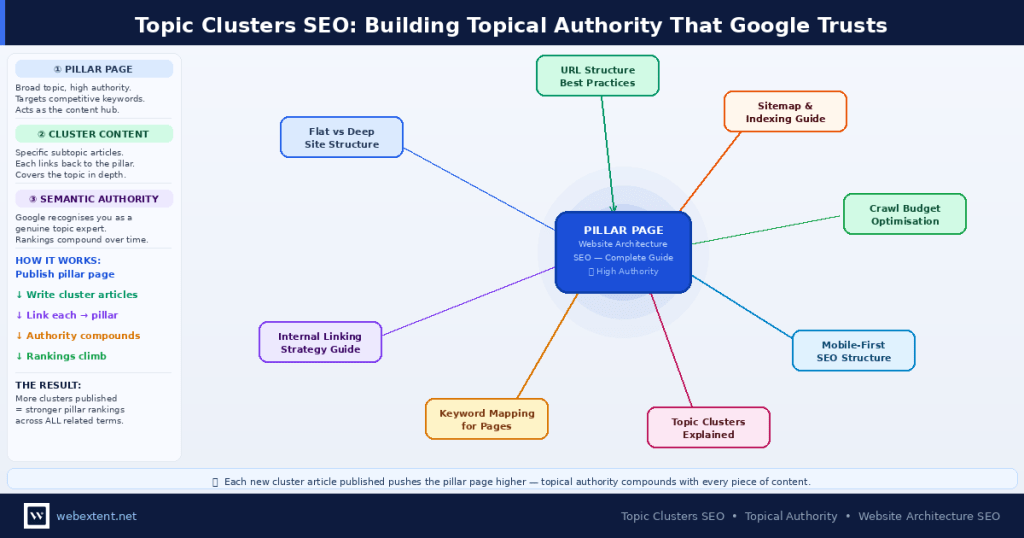
The model has three components.
Pillar pages are comprehensive resources covering a broad topic in depth. They target high-volume, competitive keywords and act as the hub of a content cluster. A web agency might create a pillar page titled ‘The Complete Guide to Website Architecture SEO.’
Cluster content consists of more specific articles that explore related subtopics. Each piece links back to the pillar page and to other relevant cluster articles. Examples for the above pillar might include: ‘How to Build a Flat Website Structure,’ ‘Internal Linking Strategy for Small Businesses,’ and ‘How to Use Topic Clusters to Build Topical Authority.’
Semantic authority is the result. Google recognises that your site covers a topic comprehensively and from multiple angles. This signals expertise and trustworthiness — two of the core signals in Google’s quality evaluation framework.
Example for a Web Agency: Pillar — Website Architecture SEO Guide | Clusters: URL Structure Best Practices, Flat vs Deep Site Structure, Internal Linking Strategy, Topic Clusters Explained, Keyword Mapping for Website Pages. Each cluster links back to the pillar, reinforcing its authority with every new piece published.
The compounding effect of topic clusters SEO means that as you publish more cluster content, the entire network — including the pillar — continues to gain authority. It’s the most scalable content strategy available in 2026.
Common Website Architecture SEO Mistakes That Silently Kill Rankings
Most of these mistakes are invisible to the naked eye. But Google sees all of them — and they cost real rankings.
Poor URL Structure
Dynamic URLs filled with parameters (`/page?id=99&type=service`) tell crawlers nothing useful. Every URL should be static, lowercase, hyphenated, and descriptive. Compare `/services/seo-audit/` against `/page?id=99` — the former wins on every SEO signal.
Too Many Categories
Spreading thin content across dozens of categories dilutes authority and confuses crawlers. If you have 12 blog categories with two posts each, consolidate them. Fewer, richer categories with stronger content consistently outperform fragmented structures.
No Keyword Mapping
Every page on your website should target a specific keyword — and no two pages should compete for the same term. Without keyword mapping, you end up with keyword cannibalism: multiple pages fighting each other for the same search query, splitting authority and confusing Google about which page should rank.
Broken Links
Every broken link wastes crawl budget and signals poor site maintenance. Run monthly audits using Screaming Frog or Ahrefs. Fix broken internal links immediately, and use 301 redirects for any deleted pages that previously had traffic or backlinks.
Missing XML Sitemap
An XML sitemap is your direct instruction to Google: ‘here are my pages, and here’s their priority.’ Without it, crawlers have to discover your content organically — a slower, less reliable process. Submit your sitemap through Google Search Console and keep it updated whenever you add new content.
Ignoring Mobile-First Indexing
Google’s primary index is based on the mobile version of your website. If your mobile navigation hides important pages, loads critical content via JavaScript, or presents a different structure than desktop, you’re being ranked on a weaker version of your site. Mobile architecture must be treated as equal to — or more important than — desktop.
Keyword Cannibalization
When two or more pages on your site target the same keyword, they compete against each other in search results. Google must choose which page to rank, often choosing neither confidently. The result: both pages rank poorly. Solve this with a keyword map that assigns one unique primary keyword per page — no exceptions.
Step-by-Step Framework to Build Website Architecture SEO
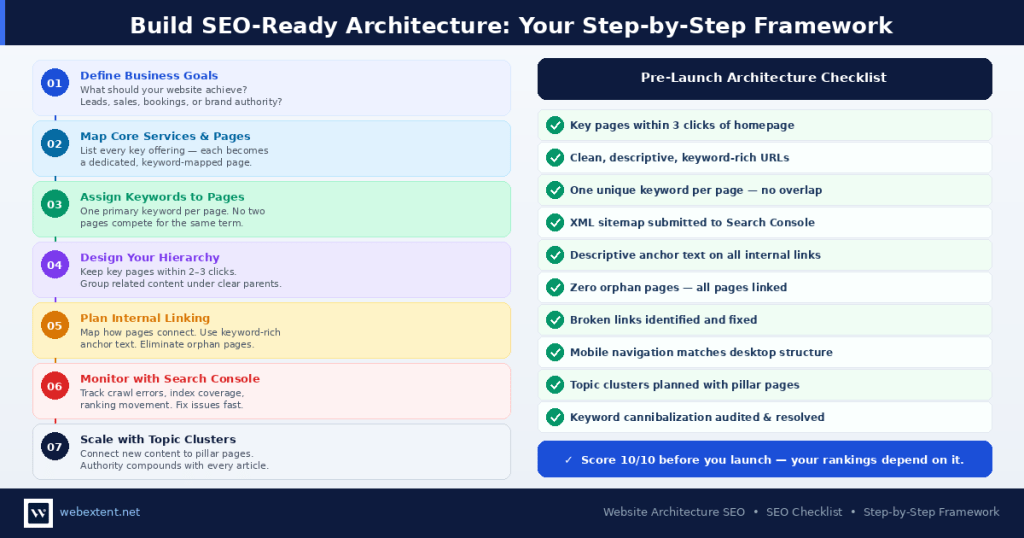
Here is a practical, seven-step roadmap for building — or rebuilding — your website’s architecture with SEO at the foundation.
- Define your business goals: What do you want your website to achieve? Lead generation, direct sales, bookings, brand authority? Your architecture should serve these goals directly. Every structural decision flows from this clarity.
- Map your core services or products: List every key offering your business provides. These become your primary pages — each one deserving its own dedicated URL and a clearly defined target keyword.
- Assign keywords to every page: Before writing a single word, complete your keyword mapping. Assign one primary keyword and two to three secondary keywords to each page. Ensure no two pages share the same primary keyword.
- Design your logical hierarchy: Sketch your site structure visually. Keep all important pages within two to three clicks of the homepage. Group related pages under clear parent categories. The structure should make intuitive sense to any first-time visitor.
- Plan your internal linking strategy: Map out how pages will link to each other. Identify your highest-authority pages and plan contextual links from those pages to service and product pages that need ranking support. Document anchor text variations for each target page.
- Monitor with Google Search Console: After launch, use Search Console to track crawl errors, coverage issues, and ranking movement. Address crawl errors immediately. Monitor for orphan pages and keyword cannibalisation patterns.
- Scale with topic clusters SEO: As you publish new content, organise it within a topic cluster framework. Every new piece should connect to a pillar page and to relevant cluster content. This ensures your content compounds in authority rather than accumulating in isolation.
Why Website Architecture SEO Must Be Planned Before Design
Here is the mistake that costs businesses thousands of dollars and months of wasted effort: designing a website before planning its architecture.
Most web design agencies lead with aesthetics. They focus on colours, layouts, and animations — and structure the site however feels intuitive in the moment. The result is often a beautiful website with no logical hierarchy, no keyword mapping, weak internal linking, and a structure that actively works against SEO goals.
After launch, business owners wonder why traffic isn’t growing. An SEO specialist is brought in to diagnose the problem and essentially rebuild the foundation of a house that’s already standing. It’s expensive, time-consuming, and entirely avoidable.
Expert Positioning: The most effective websites are architected before they are designed. Structure determines outcomes. Design communicates them.
WebExtent takes a fundamentally different approach. As an SEO-first development partner, WebExtent begins every project with architecture — not aesthetics.
The process starts with keyword mapping before development. Before a single page is designed, WebExtent identifies the search terms your target customers use and assigns each term to a specific page. This ensures every page has a purpose and a clear path to rank.
From there, WebExtent plans a logical website hierarchy structure that supports your business goals and accommodates future growth. Navigation is designed to keep key pages within two to three clicks. URLs are planned to be clean, descriptive, and keyword-aligned from day one.
The internal linking strategy is documented and built into the structure — not added as an afterthought. Authority flows efficiently from the homepage to service pages to supporting content, maximising the SEO value of every page on the site.
Finally, WebExtent designs for scalability. As your business grows and your content expands, the architecture accommodates new pages, new service areas, and new topic clusters without requiring a structural rebuild.
The result is a conversion-ready website that ranks, engages, and grows — because the foundation was right from the start.
Website Architecture SEO Quick Checklist
Before launching or relaunching your website, verify the following:
- Every important page is within 3 clicks of the homepage
- All URLs are clean, descriptive, and keyword-rich
- Every page has a unique primary keyword assigned — no overlap
- An XML sitemap is created and submitted to Google Search Console
- All internal links use descriptive, keyword-varied anchor text
- No orphan pages exist — every page has at least one internal link pointing to it
- Broken links have been identified and fixed
- Mobile navigation mirrors and supports desktop structure
- Topic clusters are planned with pillar pages and supporting cluster content
- Keyword cannibalization has been audited and resolved
Frequently Asked Questions
What is website architecture SEO and why does it matter?
Website architecture SEO refers to the intentional design of how your website’s pages are organised, connected, and structured. It matters because it directly influences how search engines crawl and index your content, how authority flows between pages, and how users navigate your site — all of which affect your rankings and conversions.
How does site structure affect Google rankings?
Your SEO site structure tells Google which pages are most important, how content relates to each other, and how efficiently it can discover and index your site. A flat, logical structure ensures crawlers reach key pages quickly, authority distributes effectively, and Google can confidently determine what your site is about.
What is a flat website structure and is it better for SEO?
A flat website structure keeps all important pages within two to three clicks of the homepage. For most small to medium businesses, this outperforms a deep structure because it improves crawlability, strengthens link authority flow, and simplifies navigation for users. Unless you’re managing thousands of pages, a flat structure is the right choice.
How does an internal linking strategy improve SEO?
A deliberate internal linking strategy moves authority from your strongest pages to those that need ranking support. It also helps crawlers discover all your content, reduces orphan pages, and reinforces topical relevance — all without requiring additional backlinks. It’s one of the highest-ROI SEO actions available to any website.
What are topic clusters and how do they build SEO authority?
Topic clusters SEO is a content strategy where one comprehensive pillar page covers a broad topic and multiple cluster articles explore specific subtopics — all linking back to the pillar. This structure signals to Google that your site has genuine depth and expertise on a subject, which builds topical authority and improves rankings across related search terms over time.
Conclusion: The Foundation Determines Everything
Website architecture is invisible to most visitors — but Google sees it all.
The businesses that dominate search results in 2026 are not necessarily the ones spending the most on advertising or producing the most content. They’re the ones who built their websites on a logical, crawlable, strategically linked foundation that Google can understand and trust.
If your traffic has plateaued, your rankings have stalled, or your website simply isn’t delivering the growth your business needs, the architecture is almost certainly a contributing factor. And the longer you operate on a weak structural foundation, the harder it becomes to fix.
The time to address your website architecture SEO is now — not after another six months of content that goes unnoticed.
WebExtent specialises in exactly this: building websites from the architecture out. If you’re planning a new website — or finally ready to get the most from the one you have — our team will map your keyword strategy, design your hierarchy, plan your internal linking, and build a structure that grows with your business.
Reach out to WebExtent today for a consultation. Let’s build something that actually ranks.
Subscribe to Us on YouTube
Get exclusive tutorials, behind-the-scenes content, and expert insights delivered directly to your feed.
We Are Available On:
Facebook:
https://facebook.com/webextent.net/
Instagram:
https://www.instagram.com/webextentofficial/
Twitter (X):
https://twitter.com/WebExtent


Leave a Reply