Every founder hits this wall eventually. As you build momentum, the question of agency vs product business starts to surface: should you focus on running a service-based agency, or shift toward building a scalable product?
This debate has been around for years, but in 2026, it carries more weight than ever. AI is reshaping what agencies can charge for, while product markets are becoming increasingly saturated. As a result, many founders who committed fully to one model without a long-term strategy are now hitting growth ceilings they didn’t anticipate.
So which model actually wins? The answer isn’t as straightforward as most advice suggests—and the right path may not be the one you’ve been told to follow.
What Is an Agency Business?
An agency sells expertise and time. You take on clients, deliver a service — marketing, development, design, SEO, strategy — and charge for the work or the result. It’s one of the oldest and most proven business models in existence.
The agency model works because it requires almost no upfront capital. Your skills are the product. And in the early stages, nothing generates revenue faster.
Pros of an Agency Business
- Low startup cost — skills matter more than funding
- Fast cash flow — clients pay weekly, monthly, or per project
- Immediate market feedback — real problems, real clients, real data
- Relationship-driven growth — referrals compound over time
- Flexibility — you can serve different industries and test niches
Cons of an Agency Business
- Time-for-money trap — more revenue demands more people
- Growth ceiling — scaling requires hiring, which compresses margin
- Client dependency — losing one anchor client can shake the whole business
- Inconsistent pipelines — feast-and-famine cycles are a real challenge
- Low asset value — agencies rarely sell for high multiples on their own
The agency model is an excellent starting point. However, without systems and a longer-term vision, it becomes a ceiling instead of a launch pad.
What Is a Product Business?
A product business builds something once and sells it repeatedly — software, tools, templates, courses, or SaaS platforms. Instead of trading time directly, you build leverage. The product works while you sleep.
The most talked-about version is SaaS. But a product business can be anything from a $49 Notion template to a $500/month B2B software subscription. The core principle is the same: one build, many sales.
Pros of a Product Business
- Highly scalable — one product can serve tens of thousands of users
- Recurring revenue — subscriptions make income predictable
- High equity value — products can be acquired, licensed, or raised on
- Passive income potential — revenue continues around the clock
- Marginal delivery costs drop as you grow
Cons of a Product Business
- High upfront investment — building takes time, money, or both
- Slow initial traction — months or even years before meaningful revenue
- Market fit risk — you can build something the market simply doesn’t want
- Ongoing maintenance — products need constant updates, support, and iteration
- Demands diverse skills — product, marketing, and tech all at once
Building a product is a long game. Therefore, patience, validation, and market proximity aren’t optional — they’re the difference between winning and wasting years.
Agency vs Product Business: Direct Comparison
Here’s how both models compare across the dimensions that actually drive decisions:
| Factor | Agency Business | Product Business |
| Startup Cost | Low | Medium to High |
| Time to First Revenue | Fast (days–weeks) | Slow (months–years) |
| Scalability | Limited | High |
| Revenue Predictability | Moderate | High (with subscriptions) |
| Equity / Asset Value | Low | High |
| Risk Level | Low to Medium | Medium to High |
| Client Dependency | High | Low |
| Passive Income | No | Yes (eventually) |
| Market Feedback Speed | Immediate | Delayed |
| Income Ceiling | Exists | Theoretically none |
Neither model wins outright. The right choice depends entirely on your stage, your resources, and where you’re trying to go.

The Reality of Agency vs Product Business in 2026
The market in 2026 looks different from what most business articles prepared you for. Here’s what’s actually happening on the ground.
AI Has Changed Agency Economics
AI tools have made many service deliverables faster and cheaper to produce. That’s useful for efficiency — but it’s also eroded the value of pure execution. Clients are increasingly asking: if AI can do this in an hour, why am I paying a monthly retainer?
As a result, agencies that sell time are feeling the squeeze. Agencies that sell strategy, systems, and measurable outcomes are thriving. The differentiation has shifted from who can do the work to who can own the result.
Product Markets Are More Crowded — But Still Winnable
There are hundreds of tools in almost every SaaS category. Meanwhile, niche products with sharp positioning and tight distribution are still finding strong traction. The ‘build it and they’ll come’ era is over. The era of building a precise solution for a specific, underserved problem — with a real distribution plan — is just beginning.
Distribution Is the Real Moat
In 2026, building is the easy part. Being found is the hard part. Whether you run an agency or sell a product, distribution determines your ceiling. The founders winning right now invested in content, community, and audience before they ever needed to sell anything. That wasn’t luck — it was strategy.
The Market Rewards Systems Thinkers
The top agency operators today run lean, efficient businesses powered by AI and well-documented processes. This discipline — systematizing delivery — is also the exact foundation needed to launch a product. In other words, the habits that make a great agency owner are the same habits that make a great product founder.
The Biggest Mistake Founders Make
Here’s something most business content glosses over.
Most founders fail at the product business because they try to build it before they’ve earned trust in the market. They spend 12 months coding a SaaS, launch it to silence, and conclude that products are too hard or too slow. The product wasn’t the problem. The timing and positioning were.
Meanwhile, most agency owners fail because they never step out of doing the work. They become the most skilled employee in their own company — and they stay there for years, wondering why the business doesn’t feel like freedom.
Key Insight: The real mistake isn’t choosing the wrong model. It’s treating this like a binary choice.
Here’s the line worth remembering: going all-in on an agency without building toward a product means trading your best years for revenue with no finish line. Going all-in on a product without agency-level market experience means building in the dark.
Both failures are avoidable. But only if you see the bigger picture.
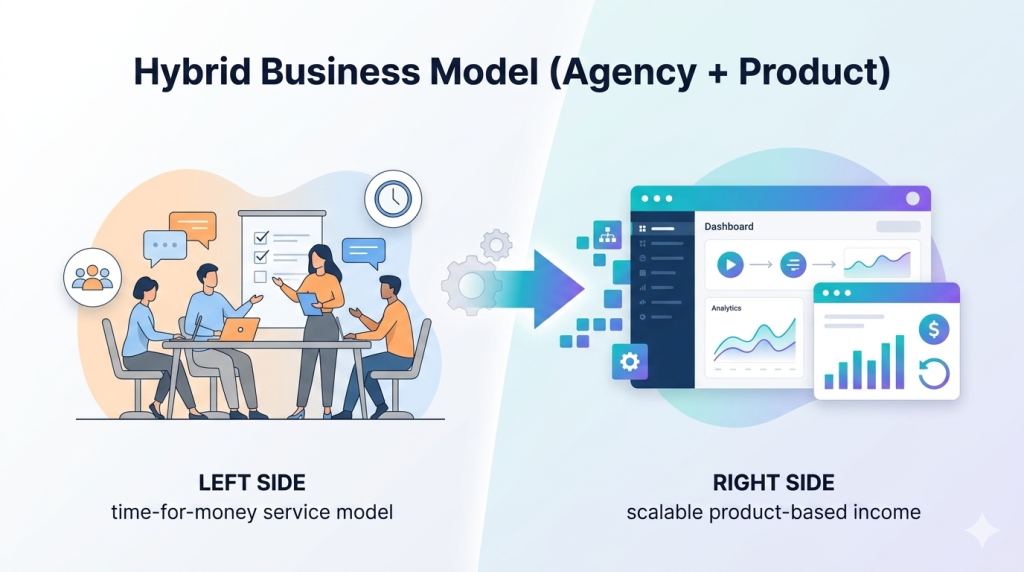
The Hybrid Model: The Smartest Play in 2026
This is the section most business articles skip. It’s also the most important one in this post.
Core Principle: The winning strategy in 2026 isn’t agency or product. It’s agency into product — built in the right sequence, at the right pace.
Phase 1: Start With the Agency (Months 0–18)
Start by delivering services. Acquire clients. Solve real problems. Learn what your market struggles with — not from podcasts or frameworks, but from actual work.
This phase gives you three things no early-stage product can provide: cash flow, credibility, and deep customer insight. These aren’t just nice-to-haves. They’re the foundation your future product will be built on.
Phase 2: Productize Your Service (Months 12–24)
Begin packaging your most repeatable work. Move from hourly billing to flat-fee, outcome-based pricing. Document your process. Build SOPs, templates, and delivery frameworks that make your service consistent and faster.
At this stage, you’re thinking like a product founder while still running an agency. Your service is becoming a system. That system is, effectively, a proto-product.
Phase 3: Launch Your Product (Month 18 Onwards)
By now, you know your customer’s pain points intimately. You’ve built a reputation. You have an email list, a social following, or a network of satisfied clients who trust you. You launch a product — a niche SaaS, a digital tool, a course — with built-in distribution.
This is what makes the hybrid approach so powerful: you’re not guessing what the market needs. You already know, because you’ve been living inside the problem.
Real-World Examples of the Hybrid Approach
- A content marketing agency that turned its internal editorial process into a paid content strategy template kit — generating passive revenue from the exact systems they built for clients.
- A design agency that packaged its brand identity workflow into a premium Figma template pack, launching to an existing audience of past clients and followers.
- A development agency that built an internal project scoping tool, then launched it as a standalone SaaS after realizing every agency they knew had the same problem.
At Webextent, we’ve seen this pattern repeat consistently enough that it’s shaped how we think about growth — both for ourselves and for the founders we work with. The gap between ‘internal agency tool’ and ‘market-ready product’ is almost always smaller than people assume.
Which One Should You Choose?
Here’s a practical decision guide based on where you actually are right now.
If You’re a Beginner (Year 0–1)
Verdict: Start with the agency. No debate.
You need cash flow to survive. You need market education to build anything valuable. Go get clients, deliver real work, and pay close attention to the patterns — what problems keep coming up, what your clients actually want, where they feel stuck.
You’re not just building a business. You’re doing research that will eventually fund a product.
If You’re at an Intermediate Stage (Years 1–3)
Verdict: Productize your service and start thinking about your first product.
Raise your prices. Package your delivery. Build systems that let the work run without you being in every piece of it. Then look at the problems you’re solving repeatedly — those are your product ideas.
From our experience at Webextent, this is the exact stage where most founders either plateau or break through. The difference is almost always whether they’ve started building leverage — through systems, content, or a product — instead of just taking on more client work.
If You’re an Advanced Founder (Years 3+)
Verdict: Go hybrid deliberately and with full intention.
If your agency is established, you have the cash flow and credibility to fund a product launch. Use your existing client base as beta users. Build in public. Let your agency reputation accelerate your product distribution.
If you already have a product, consider adding a consulting or agency arm. It can self-fund further product development and give you the kind of direct market feedback no analytics dashboard can replicate.
Final Verdict
The Bottom Line: The agency wins faster. The product wins longer. The hybrid wins both.
If you need revenue quickly with manageable risk, start with the agency. For those aiming for equity, leverage, and passive income, building a product is the better path. And if your goal is to create a business that compounds over time—as it should—then the smartest move is to sequence both.
The agency vs product business debate is really a question of timing, not a question of which model is superior. Both work. Both have limits. The founders who combine them intentionally are the ones who build something durable.
This is the approach we’re building at Webextent — treating agency delivery and product thinking not as competing paths, but as two connected stages of the same long game.
Frequently Asked Questions
1. What is the core difference between agency vs product business?
An agency sells expertise and time — you deliver a service to clients directly and charge for it. A product business builds something once and sells it repeatedly. In the service vs product business comparison, the fundamental difference is leverage: services scale with people, products scale with systems. One is linear. The other is exponential.
2. Is agency or SaaS better for building long-term wealth?
In a direct agency vs SaaS comparison, a SaaS product typically generates greater long-term wealth because of recurring revenue, lower delivery costs over time, and higher acquisition multiples. However, a SaaS demands more upfront investment and carries real market-fit risk. An agency gets you to revenue. A product gets you to wealth. The smartest path uses both in sequence.
3. Can you run an agency and a product business at the same time?
Yes — and many of the most successful founders do exactly that. The hybrid approach uses agency cash flow and client insight to fund and validate a product. It requires strong systems and clear priorities to execute well, but it remains one of the most practical scalable business models available to founders today.
4. When is the right time to transition from an agency to a product?
The right time is when you have three things: a service you’ve delivered repeatedly, a deep understanding of your customer’s core problem, and some form of distribution. Moving from a product vs service business standpoint too early — before you have market clarity and cash flow — is one of the leading reasons early-stage product launches fail quietly.
5. What makes a business model scalable in 2026?
Among scalable business models in 2026, niche SaaS tools, productized services, and digital products with strong distribution lead the way. The shared principle: revenue grows faster than the cost of delivering it. A well-systematized agency business model can also scale — but only when it moves beyond time-based billing and toward outcomes, systems, and leverage.
Conclusion
In 2026, the business landscape rewards one thing above everything else: builders who are close to the market and smart about leverage.
AI is changing what agencies can charge for. Product markets are competitive. And the days of picking a model, ignoring the rest, and grinding your way to success are fading fast. However, the fundamentals haven’t changed. Solve real problems. Build real systems. Create real value.
The agency vs product business question will keep evolving as technology shifts. But the founders who stay adaptable, build with intention, and think in sequences — not just sprints — will win across every market cycle.
Stop treating this as a choice. Start treating it as a roadmap.
Now go build something that lasts.
Subscribe to Us on YouTube
Get exclusive tutorials, behind-the-scenes content, and expert insights delivered directly to your feed.
We Are Available On:
Facebook:
https://facebook.com/webextent.net/
Instagram:
https://www.instagram.com/webextentofficial/
Twitter (X):
https://twitter.com/WebExtent


Leave a Reply