

You published the blog post. Then you hit publish—and waited. But nothing happened. Without a WordPress SEO content system, even well-written content can struggle to rank or attract traffic.
Sound familiar? The truth is, most WordPress sites don’t fail because of bad content—they fail because they lack a clear, repeatable system. Without structure, even great posts fail to generate consistent results or long-term growth.
SEO without a system is just guesswork dressed up in keywords. You might get lucky once in a while, but luck doesn’t build a sustainable traffic engine. What actually works is a structured, repeatable approach that turns every piece of content into a long-term asset.
In this guide, you’ll learn how to build a complete WordPress SEO content system from scratch—one that works in 2026, adapts to AI-driven search changes, and helps you grow consistent organic traffic over time.
Let’s get into it.
What Is a WordPress SEO Content System?
A WordPress SEO content system is a structured, ongoing process that connects keyword research, content creation, on-page optimization, and authority building into one unified strategy. Rather than treating each blog post as a standalone piece, this approach treats your entire site as an interconnected web of content — where each page supports the others.
Think of it like a machine. When all parts work together — your foundations, your content output, your technical optimizations, and your backlink profile — the machine keeps running even when you’re not actively pushing it. That’s the power of an SEO content framework.
Without a system, your SEO efforts are fragmented. You might write great posts but neglect internal linking. You might build backlinks but publish content that doesn’t match search intent. A proper SEO growth system eliminates these gaps and gives every action a clear purpose.
The 4 Pillars of a High-Performing WordPress SEO Content System
Every strong WordPress SEO system is built on four core pillars. Skip any one of them and the whole structure weakens. Master all four and you’ll have a content engine for SEO that keeps delivering results month after month.
Pillar 1: Foundation of Your WordPress SEO Content System
Before you write a single word, your site’s foundation needs to be solid. This is the technical base that tells search engines your site is trustworthy and crawlable.
Here’s what your foundation should include:
- A fast, mobile-optimised WordPress theme (Core Web Vitals matter more than ever in 2026)
- Clean permalink structure (e.g., yoursite.com/blog/post-title)
- A reliable SEO plugin (Yoast SEO or Rank Math) configured properly
- An XML sitemap submitted to Google Search Console
- HTTPS enabled and canonical URLs set to avoid duplicate content
- Schema markup for key pages (articles, FAQs, products)
Think of your foundation as the soil. Even the best seeds won’t grow well in poor conditions. However, many WordPress site owners skip this step entirely — and they wonder why their traffic flatlines.
Pillar 2: Content Engine in Your WordPress SEO Content System
Your content engine is the heart of your WordPress SEO content system. This is where strategy meets execution. However, it’s not just about publishing frequently — it’s about publishing the right content in the right format for the right audience.
The content engine framework looks like this:
- Keyword research: Use tools like Ahrefs, Semrush, or Google’s own Search Console to find low-competition, high-intent keywords your audience is searching for.
- Content mapping: Assign keywords to content types — pillar pages for broad topics, cluster posts for specific sub-topics.
- Search intent matching: Before you write, ask: is the searcher looking to learn, buy, compare, or navigate? Your content must match that intent.
- Content calendar: Establish a consistent publishing rhythm. Even two quality posts per month beat ten rushed ones.
- Content depth: In 2026, thin content simply doesn’t rank. Cover your topic comprehensively. Answer follow-up questions before readers even ask them.
A well-run content engine for SEO turns your WordPress site into a publishing machine that consistently attracts qualified organic traffic — week after week, month after month.

Pillar 3: Optimization Layer in Your WordPress SEO Content System
Publishing content is only half the job. The optimization layer is where you fine-tune each piece to maximise its chances of ranking. This is the on-page SEO work that most people rush through — or skip entirely.
Key optimization tasks include:
- Including your target keyword in the title, first 100 words, H2 headings, and meta description
- Writing descriptive, click-worthy title tags under 60 characters
- Using related semantic keywords naturally throughout the content
- Adding internal links to related posts and pages (at least 2–3 per post)
- Optimizing images with descriptive alt text and compressed file sizes
- Structuring content with clear H2 and H3 headings that reflect what readers are searching for
In addition, don’t forget to update old content. Your optimization layer isn’t a one-time task. Therefore, schedule quarterly content audits to refresh outdated posts, add new internal links, and improve underperforming pages.
Pillar 4: Authority Layer of Your WordPress SEO Content System
Google doesn’t just rank content — it ranks trusted sources. Your authority layer is all about building the credibility signals that tell search engines your site deserves to be at the top.
Authority building in 2026 involves:
- Earning backlinks from relevant, high-quality websites through guest posts, digital PR, and data-driven content
- Demonstrating author expertise through bios, credentials, and consistent publishing under real names
- Getting cited or mentioned in niche publications and industry forums
- Building a social presence that drives brand searches (a growing ranking factor)
- Establishing E-E-A-T signals (Experience, Expertise, Authoritativeness, Trustworthiness) across your site
Authority takes time, but it’s the layer that makes your SEO content framework truly unstoppable. Once you’ve built it, even a modest amount of new content can rank quickly.
Weekly Workflow for Your WordPress SEO Content System
Knowing the pillars is great. But how do you actually run a WordPress SEO system week to week? Here’s a practical workflow you can start using right now.
Monday — Strategy & Planning (30–45 mins)
- Review Google Search Console data from the past 7 days
- Identify which posts gained or lost impressions
- Select one keyword to target for this week’s new post
- Check competitor content for any content gaps you can fill
Tuesday–Wednesday — Content Creation (2–3 hours)
- Write one long-form, well-researched post targeting your chosen keyword
- Structure it with clear H2 and H3 headings
- Add internal links to at least three related posts
- Include a FAQ section to capture voice and featured snippet traffic
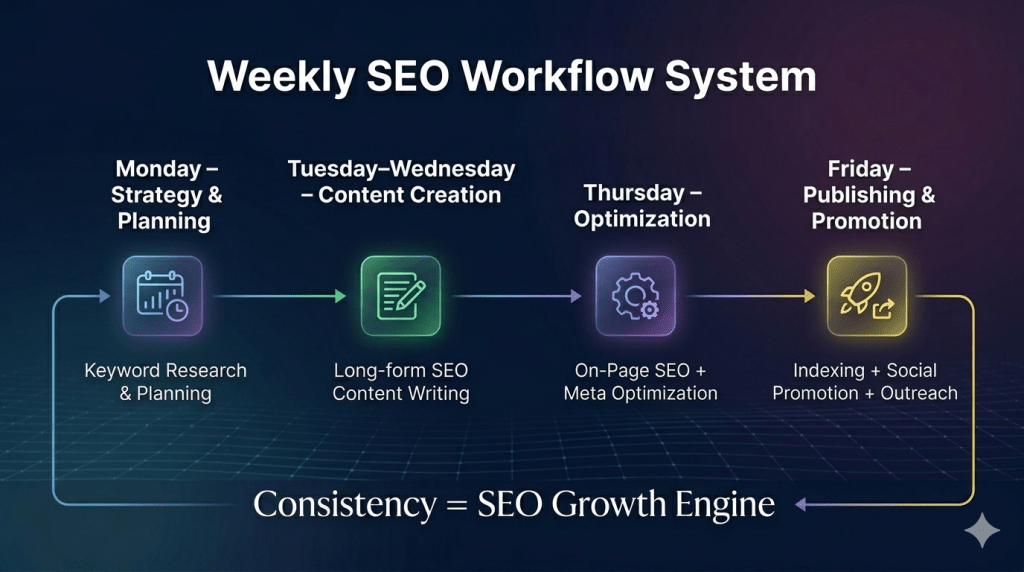
Thursday — On-Page Optimization (45 mins)
- Run the post through your SEO plugin (Yoast or Rank Math)
- Optimize title tag, meta description, and slug
- Add schema markup if relevant (Article, FAQ, HowTo)
- Compress all images and add alt text
Friday — Publishing & Promotion (30 mins)
- Publish the post and submit URL to Google Search Console for indexing
- Share on social channels and in relevant communities
- Send to your email list if you have one
- Reach out to two or three sites for potential link-building opportunities
This simple weekly rhythm, done consistently, is what separates WordPress sites that grow from those that stay stuck at a few hundred monthly visitors.
Why Most WordPress SEO Content Systems Fail (And How to Fix Them)
Before we move on, let’s talk about the most common reasons WordPress SEO doesn’t deliver results — because avoiding these mistakes is just as important as following the right strategy.
1. Treating SEO as a One-Time Task
SEO is not a setup-and-forget job. Algorithms evolve, competitors publish new content, and search trends shift. Therefore, your WordPress SEO system needs to be a living, breathing ongoing process — not something you set up once and ignore.
2. Chasing Keywords Without Strategy
Many site owners target high-volume keywords that have no realistic chance of ranking. Instead, your SEO content framework should prioritise medium and long-tail keywords where you can genuinely compete — and build up to harder terms over time.
3. Ignoring Internal Linking
Internal links are one of the most underrated parts of a WordPress SEO content system. They pass authority between pages and help Google understand your site structure. Neglecting them is like building a city with no roads connecting the neighbourhoods.
4. Publishing Without Promoting
Publishing content without promotion is whispering in a crowded room. Even the best content needs an initial push. In addition, early engagement signals (time-on-page, clicks, shares) can accelerate how quickly Google starts ranking a new post.
5. Not Measuring What Matters
If you’re not tracking keyword rankings, organic traffic, and conversion rates from organic search, you’re flying blind. Your SEO growth system must include regular measurement — otherwise you won’t know what’s working or where to double down.
Turning Your WordPress SEO Content System into a Growth Engine
Here’s the exciting part. Once your SEO system is running, it starts to compound. A post you published six months ago keeps bringing in traffic. An old piece of content you updated starts ranking for new keywords. The links you earned three months ago begin lifting newer posts.
This compounding effect is the real power of a proper WordPress SEO system. Unlike paid ads, which stop the moment you stop paying, SEO builds equity. Every post, every optimized page, every earned backlink — they all add up.
To accelerate this growth engine, here’s what to focus on:
- Build topic clusters: One pillar page supported by multiple related cluster posts creates a powerful signal of topical authority.
- Update before you create: Refreshing an existing post is often faster and more effective than writing a new one from scratch.
- Optimise for clicks: A higher click-through rate in search results is a strong ranking signal. Test different title formats to improve your CTR.
- Repurpose content: Turn your blog posts into YouTube videos, infographics, or social media carousels to attract links and traffic from multiple channels.
The goal isn’t to be everywhere. The goal is to build a content engine for SEO that consistently brings the right audience to your site and converts them into customers or loyal readers.
WPExtent: Your WordPress SEO Content System Growth Partner
Building a WordPress SEO content system from scratch is genuinely rewarding — but it’s also time-consuming and complex. That’s where WPExtent comes in.
WPExtent is built for WordPress businesses that are ready to treat SEO as a growth strategy, not an afterthought. The team at WPExtent doesn’t just run tactical SEO tasks — they build complete, system-based SEO frameworks tailored to your niche, your audience, and your goals.
Here’s what sets WPExtent apart as an SEO growth partner:
- Deep WordPress expertise: WPExtent understands WordPress at a technical level — from site speed and crawlability to plugin conflicts and schema implementation.
- System-first approach: Instead of random tactics, WPExtent builds a cohesive SEO content framework specific to your business — covering all four pillars from day one.
- Ongoing execution: WPExtent doesn’t hand you a document and disappear. They stay in your corner, executing week after week, measuring results, and adapting the strategy as needed.
- Transparent reporting: You’ll always know exactly what’s happening with your organic traffic, keyword rankings, and content performance.
Whether you’re starting from zero or looking to scale a system you’ve already started, WPExtent can help you build something that actually grows.
Ready to turn your WordPress site into a predictable traffic engine?
Let WPExtent build your SEO content system—so you can focus on scaling your business.
Frequently Asked Questions (FAQ)
What is a WordPress SEO content system?
A WordPress SEO content system is a structured approach to creating, optimizing, and promoting content on your WordPress site in a way that consistently drives organic traffic. It connects keyword research, content creation, on-page SEO, and authority building into one coordinated strategy — rather than treating each task in isolation.
How long does SEO take to show results?
SEO typically takes between three and six months to show meaningful results for newer sites, and sometimes faster for established domains. However, this depends on your niche’s competition level, how frequently you publish, your site’s domain authority, and how well-optimized your content is. Consistent effort over time is the single biggest driver of SEO success.
Is SEO still worth it in 2026?
Absolutely. In fact, with AI-generated content flooding the internet, well-researched and genuinely helpful human-led content has become more valuable — not less. Google continues to reward expertise, trust, and depth. A strong SEO growth system in 2026 means focusing on quality and consistency, which still delivers outstanding ROI compared to paid advertising.
Do I need an SEO plugin for WordPress?
Yes. An SEO plugin like Yoast SEO or Rank Math is an essential part of your WordPress SEO system. These plugins help you optimize meta titles and descriptions, generate XML sitemaps, add schema markup, manage canonical URLs, and analyse your on-page SEO in real time. They are relatively easy to set up and make a significant difference to your visibility in search results.
How many blog posts do I need to publish per month?
Quality beats quantity every time. For most WordPress sites, publishing two to four well-researched, properly optimized posts per month is more effective than publishing fifteen thin pieces. Focus on covering your core topics deeply and building topic clusters around your most important keywords. As your system matures, you can increase publishing frequency.
Can WPExtent build an SEO content system for my WordPress site?
Yes. WPExtent specialises in building custom WordPress SEO content systems for businesses of all sizes. From technical foundations and keyword strategy to content creation and authority building, WPExtent handles the entire process. If you’re ready to turn your WordPress site into a traffic-generating growth engine, WPExtent is the partner to help you get there.
Conclusion
Building a WordPress SEO content system isn’t about chasing the latest algorithm update or publishing content for the sake of it. It’s about creating a reliable, repeatable process that turns your WordPress site into a traffic-generating asset.
The four pillars — Foundation, Content Engine, Optimization Layer, and Authority Layer — give you a complete picture of what’s required. The weekly workflow gives you a practical way to make consistent progress without burning out. And understanding the common pitfalls helps you avoid the mistakes that derail most WordPress SEO efforts.
Most importantly, remember this: SEO rewards patience and consistency. The sites that win in search are the ones that keep showing up — week after week, month after month — with helpful, well-optimized content.
Start today. Build your system. And if you want expert support along the way, WPExtent is ready to be your SEO growth partner for the long haul.
Follow WPExtent for More Insights
Get practical WooCommerce tips, conversion strategies, and real-world insights to grow your online business.
We Are Available On:
Instagram:
https://www.instagram.com/thewpextent
Twitter (X):
https://x.com/TheWPExtent
Reddit:
https://www.reddit.com/user/WPExtent/



Leave a Reply